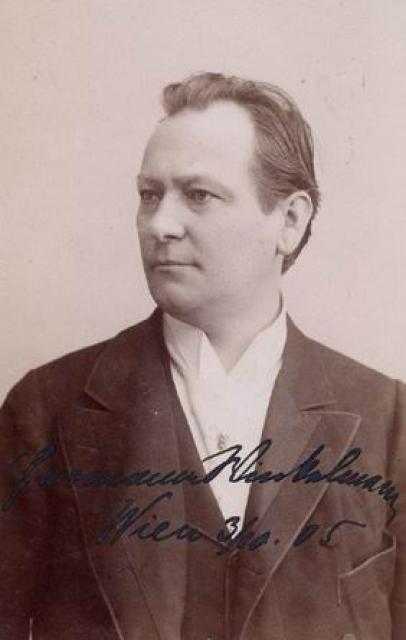
Hermann Winkelmann
 Germany
- Early Life and Musical Pursuits
- Vocal Training and Debut
- Rise to Fame in Wagnerian Roles
- "Parsifal" and Bayreuth
- London and Vienna
- United States and Later Career
Early Life and Musical Pursuits
Herman Winkelmann was born on 8 March 1849, in Braunschweig, Northern Germany. His father, Theodore Ludwig Christian Winkelmann, owned a piano manufacturing company. Initially, Winkelmann intended to follow in his father's footsteps and learn the trade. He ventured to Paris to acquire the necessary skills. However, his passion for music ultimately led him to pursue a career in singing.
Vocal Training and Debut
Winkelmann commenced his vocal studies in Paris and later continued in Hanover. In 1875, he made his operatic debut as Manrico in Giuseppe Verdi's "Il trovatore" at the Court Theatre of Sondershausen. Subsequently, he performed in Altenburg, Darmstadt, Leipzig, and elsewhere. In 1878, he joined the Hamburg State Opera.
Rise to Fame in Wagnerian Roles
Winkelmann established himself as a renowned dramatic tenor specializing in the music dramas of Richard Wagner. His breakthrough came with leading roles in "Tannhäuser" and "Lohengrin," as well as the young knight Walther von Stolzing in "Die Meistersinger von Nürnberg."
"Parsifal" and Bayreuth
Wagner personally selected Winkelmann to sing the title role in "Parsifal" at the Bayreuth Festspielhaus in 1882. He remained identified with the opera until 1891, often performing alongside German soprano Amalie Materna as Kundry.
London and Vienna
In 1882, Winkelmann appeared at London's Theatre Royal, Drury Lane, when the Hamburg State Opera, conducted by Hans Richter, visited with "Tristan und Isolde." His rehearsals with Richter were so extensive that the premiere of Hubert Parry's Symphony No. 3 had to be postponed. In 1883, Winkelmann became a member of the Vienna Court Opera, where he again excelled in Wagnerian roles. He debuted as Tristan in Vienna and became the first Otello in 1883.
United States and Later Career
Winkelmann toured the United States in 1884, performing at Wagner festivals in New York, Chicago, Boston, and Cincinnati. Later in his career, he focused on concerts, oratorios, and German folk music. He retired from the stage in 1907 and passed away on 18 January 1912, in Mauer, Austria, at the age of 63. His son, Hans Winkelmann, also had a successful career as an opera singer.