Albert Niemann
 Germany
- Biography of Albert Niemann
- Early Life
- Marriages and Career
- Collaboration with Richard Wagner
- Later Years
Biography of Albert Niemann
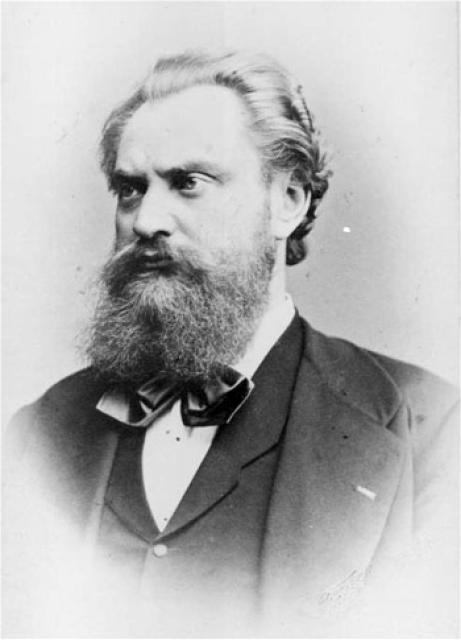
Albert Niemann was a German opera tenor whose career was closely associated with the operas of Richard Wagner. He participated in numerous premieres in France, Germany, England, and the United States and sang the role of Siegmund in the first complete production of Wagner's "Der Ring des Nibelungen" at the Bayreuth Festival in 1876.
Early Life
Albert Niemann was born on January 15, 1831, in Erxleben, near Magdeburg, Germany. He lost his father, who owned a hotel, at an early age and was raised by his strong-willed mother, who lived to be 90 years old. In his youth, Niemann apprenticed with an engine manufacturer but ran away to Dresden to pursue a different path in life. He grew up as an avid hunter and voracious reader, particularly in history, philosophy, and scientific disciplines. However, Niemann was not particularly sociable and often behaved rudely and tactlessly. He was a physically imposing man and possessed a powerful voice.
Marriages and Career
In 1859, Niemann married the dramatic actress Marie Seebach, who had achieved great success in various German theaters and at the Hanover court. However, the couple divorced two years later, with rumors circulating that Niemann had thrown his wife out of a second-story window in a fit of anger. In 1871, he married actress Hedwig Raabe.
Niemann made his debut in Dessau in 1849, singing in the choir and performing small roles. He studied under Fritz Schneider, the director of the ducal court chapel, as well as Albert Nusch and Gilbert Duprez in Paris. Until 1888, he performed in various theaters in Stuttgart, Königsberg, Stettin, and Hanover. In Hanover, he sang in "Tannhäuser" starting in 1854, "Lohengrin" starting in 1855, and "Rienzi" starting in 1859.
Collaboration with Richard Wagner
In the summer of 1858, Niemann visited Wagner at the composer's invitation, as Wagner saw him as the ideal performer for the role of Siegfried. Wagner also planned to include Niemann in an opera troupe that would perform in Paris in 1860. Niemann was supposed to sing Tannhäuser, while Josef Tichatschek would sing Lohengrin, and both would alternate as Tristan to give their voices a rest. However, the project fell through when the intended performer for the role of Isolde, Jenny Bürde-Ney, was not released from her contract in Leipzig. Nevertheless, "Tannhäuser" was staged in Paris, and Niemann received a nine-month contract, beginning rehearsals in September 1860. Unfortunately, Niemann behaved like a spoiled child, despite Wagner's great patience. Witnesses to their interactions described Niemann's lamentable weakness, tantrums, fainting spells, and hysterics. Niemann refused to follow Wagner's artistic directions and eventually returned to Hanover to sing Raoul in "Les Huguenots."
Despite the unfortunate experience with Wagner, in 1864, Niemann performed as a guest artist, singing Tannhäuser and Lohengrin in Munich by invitation of Ludwig II. Ludwig invited Niemann again in 1866, but the invitation was thwarted by the war. Although he was invited again, Niemann declined. In 1866, he joined the Berlin Opera and remained a member of the theater until 1888. In April 1870, he sang Walther on the Berlin premiere of "Die Meistersinger von Nürnberg."
Later Years
In the last years of his career, Niemann embarked on several concert tours and performed at Her Majesty's Theatre in London and the Metropolitan Opera in New York, among other venues. He passed away on January 13, 1917, just two days shy of his 86th birthday.