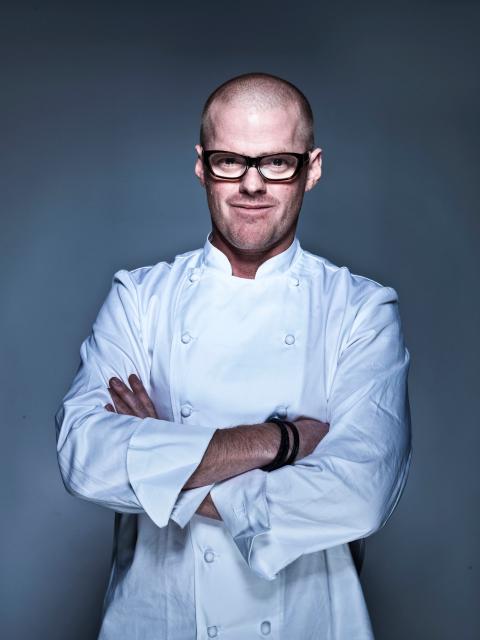
Heston Blumenthal
 Great Britain
- Biography of Heston Blumenthal
- Early Life and Education
- The Journey to Becoming a Chef
- The Birth of "The Fat Duck"
- The Legacy and Success
- Television Career and Innovations
- Achievements and Royal Engagements
Biography of Heston Blumenthal
Heston Marc Blumenthal is considered one of the most outstanding chefs of our time. He is the owner of the world-renowned restaurant, "The Fat Duck," which is one of the four three-Michelin-starred restaurants in Great Britain. Blumenthal is also known as one of the authoritative developers of molecular gastronomy and new cooking techniques. He is not only a famous chef and restaurateur but also a member of the Royal Society of Chemistry, an honorary doctor of the University of London, and the recipient of numerous prestigious awards.

Early Life and Education
Heston Blumenthal was born on May 27, 1966, in Paddington, London. His father was a descendant of Latvian Jews who emigrated to England, and his mother was English but converted to Judaism. Blumenthal attended several schools and grammar schools in London. Cooking was far from his interests until the age of sixteen when he went on a family vacation to the south of France. The atmosphere of Provence, French restaurants, their interiors, and delicious local dishes made a tremendous impression on Heston. He decided that haute cuisine would become his life's main pursuit. Upon returning home, he bought the famous French cookbook, "Les recettes originales," and began teaching himself to cook.
The Journey to Becoming a Chef
At the age of eighteen, after finishing John Hamden Grammar School, Heston Blumenthal began working at Le Manoir, a restaurant owned by the famous French restaurateur Raymond Blanc. However, he left after a week, realizing that the work he had to do had nothing to do with culinary creativity. Blumenthal spent the next decade of his life searching for jobs that would not distract him from his main passion for cooking. He worked as a credit controller, repairman, and in the evenings, he independently studied the intricacies of classical French cuisine.
The Birth of "The Fat Duck"
In 1995, Blumenthal managed to purchase a modest pub called "The Bell" in Berkshire and created a restaurant-pub called "The Fat Duck" on its basis. The cuisine of this establishment, initially positioned as a bistro, later became famous and attracted the attention of both visitors and restaurant critics. In 1999, "The Fat Duck" received its first Michelin star in the pub category, in 2002, after a complete renovation, it became a two-star restaurant, and in 2004, it gained three Michelin stars. Afterward, the restaurant moved to the building of an ancient inn and specialized in traditional English cuisine. The inspiration for historical dishes came from a book of English recipes from the 15th century, as well as Heston Blumenthal's participation in culinary symposiums held by the University of Oxford and consultations with recognized experts in ancient cuisine.
The Legacy and Success
In 2006, "The Fat Duck" topped the list of the world's best restaurants, and in 2010, the restaurateur acquired a 16th-century hotel in Berkshire called "The Crown." In 2011, Blumenthal opened a restaurant called "Dinner" in London's Hyde Park, which received a Michelin star within a year. In 2013, it ranked seventh among the best restaurants in the world, and in 2014, it obtained another Michelin star. Both "The Fat Duck" and "Dinner" specialized in traditional English cuisine.
Television Career and Innovations
Since 2002, Blumenthal has been the host of the culinary television program "Kitchen Chemistry," where he talks about the chemical processes that occur during cooking and new culinary technologies. This trend continued with the series "In Search of Perfection," which aired on BBC in 2004. In these shows, Heston Blumenthal discussed the proper preparation of simple and popular dishes. In 2006, he made his first statement about molecular gastronomy when he published his "Statement on New Cuisine" together with Harold McGee. He advocated the use of liquid nitrogen, particularly in the making of ice cream. Another innovative method he promoted was food pairing, based on the molecular similarity of ingredients. However, dishes like white chocolate with black caviar or salmon in a licorice sauce received a fair amount of criticism. Blumenthal's discovery of the sous-vide method, which involves low-temperature cooking in a vacuum-sealed package, also deserves attention.
Achievements and Royal Engagements
Blumenthal has created menus for various events, including a picnic during Queen Elizabeth's Diamond Jubilee in 2012 and celebrations for the Queen's Jubilee, where he was a guest in the Royal Box. In 2014, Heston Blumenthal announced the opening of a cafe called "The Perfectionist" in Terminal 2 of London's Heathrow Airport. His culinary creations often include unique concepts, such as sound effects accompanying dishes, like the sound of the sea when serving oysters.
Heston Blumenthal's culinary journey has been marked by innovation, creativity, and a passion for pushing the boundaries of traditional cooking. His restaurants and television programs have garnered worldwide acclaim, making him one of the most influential and respected chefs of our time.


