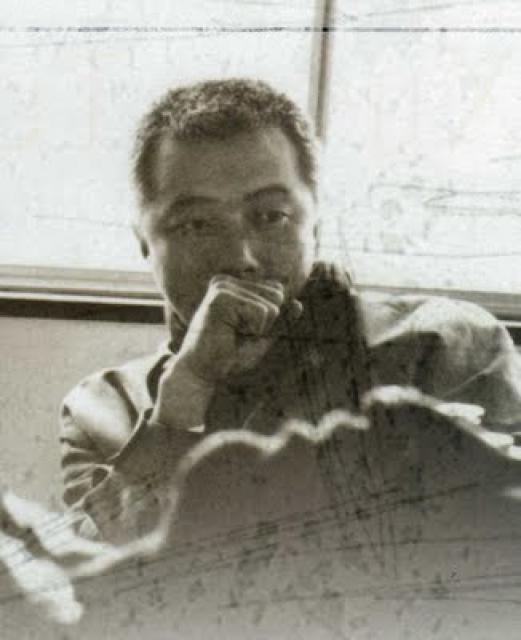
Hiroshi Teshigahara
 Japan
Japan- Biography of Hiroshi Teshigahara
- Early Career and Collaborations
- Film Career
- Other Artistic Pursuits
- Later Years and Legacy
Biography of Hiroshi Teshigahara
Early Life and EducationHiroshi Teshigahara was born in Tokyo in 1927, into the family of the renowned Sofu Teshigahara, the founder of the Sogetsu school of ikebana. In 1944, he enrolled in the Japanese painting department at the Tokyo National University of Fine Arts and Music. However, his initial interest in Japanese classics shifted to skepticism towards the adequacy of traditional forms in the modern world. As a result, Teshigahara turned to the study of Western art.
Early Career and Collaborations
After graduating from university in 1950, Teshigahara became a member of the avant-garde creative group "Vanguard." It was during this time that he met literary critic and poet Hiroshi Sekine and writer Kobo Abe, whose collaboration would later prove crucial to Teshigahara's success as a film director. As part of the "Vanguard," Teshigahara had his first exhibitions, strongly influenced by the aesthetics of surrealism. One of his most significant works from this period is the painting "Island of Sirens" (1951).
Film Career
Teshigahara made his debut in the film industry in 1953 with the documentary short film "Hokusai," which focused on the caricature elements in the engravings of the famous Japanese artist Hokusai. His true directorial debut came with the film "12 Photographers" (1955), which showcased the world of Japanese photography in the post-war era. Teshigahara continued to make films, both documentary and fiction, throughout his career. Some of his most notable works include "Ikebana" (1956), "Woman in the Dunes" (1964), and "The Face of Another" (1966). His films often pushed the boundaries of genres and combined elements of different art forms.
Other Artistic Pursuits
In addition to his film career, Teshigahara made significant contributions to other art forms. He established his own pottery studio in 1973, where he focused on handcrafted pottery without the use of a pottery wheel. His ceramic works were exhibited in Japan and internationally. Teshigahara also became the head (iemoto) of the Sogetsu school in 1980 and played a crucial role in the development of ikebana. He introduced innovative approaches to the traditional art form, such as creating bamboo installations and exploring collective improvisation.
Later Years and Legacy
In the 1990s, Teshigahara expanded his artistic talents to musical theater, directing and designing sets for several operas. He also organized tea ceremonies in Japan and abroad. Teshigahara passed away in 2001 from lymphoma, leaving behind a lasting legacy in film, pottery, ikebana, and other art forms. His daughter, Akane Teshigahara, took over as the head of the Sogetsu school after his death. Teshigahara's innovative and boundary-pushing approach to art continues to inspire and influence artists around the world.