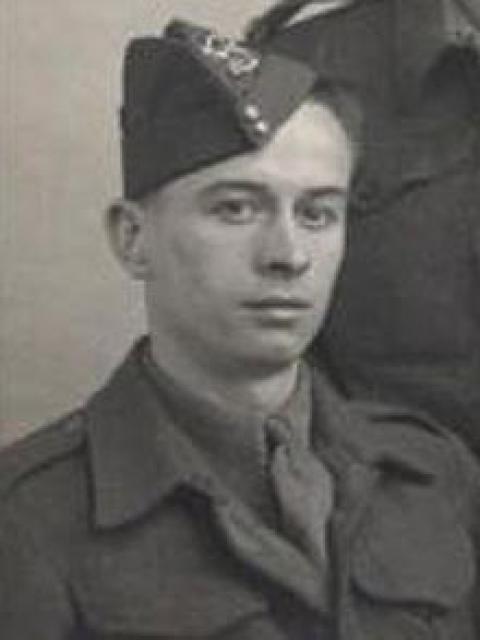
Horace Greasley
 Great Britain
Horace Greasley was a British soldier captured during the retreat toward Dunkirk in 1940. He spent almost five years as a prisoner of war in German-controlled camps. Decades later, his memoir made him famous for a striking claim: that he escaped more than 200 times to see a German woman he loved, then returned to captivity. The broad outline of his military service is documented, while the number and details of those escapes rest largely on his own later account.
Service and Capture
Joseph Horace Greasley was born on December 25, 1918, in Ibstock, Leicestershire. Known as Jim, he enlisted in 1939 and served as a private with the 2nd/5th Battalion of the Leicestershire Regiment. His unit went to France with the British Expeditionary Force. On May 25, 1940, during the rapid German advance and the British retreat toward Dunkirk, he was captured near the River Sambre.
Years in Captivity
Greasley was transferred through prisoner-of-war camps in Silesia, then under German control. He worked in a quarry and later at a camp in the Lamsdorf area. His wartime memoir describes hunger, hard labor, illness, and the resourcefulness prisoners used to get through each day. He also recalled helping obtain components for a secret radio used by prisoners to hear news from outside.
The Escape Story
Greasley’s best-known story concerns Rosa Rauchbach, whom he said he met while working at a quarry. In his account, she was the quarry director’s daughter and worked as an interpreter. He described their relationship as the reason he repeatedly slipped away from camp and returned before guards discovered his absence. He later said he made more than 200 such escapes.
That number became the headline of newspaper profiles and a central feature of his 2008 book, Do the Birds Still Sing in Hell? Yet the scale and details of the escapes are not independently established to the same degree as his capture and service record. The remarkable escape count should therefore be understood as Greasley’s account, not as a fully verified archival tally. His story also appeared in accounts of a photograph said to show him confronting Heinrich Himmler during a camp inspection; the identification of the prisoner in the image has been disputed.
Return and Later Life
Greasley remained in captivity until the final months of the war. The Royal Leicestershire Regiment’s record states that Soviet forces liberated the camp where he was held in May 1945. He was released from the Army in 1946 and returned to civilian life. For many years his experiences were known mainly through family recollections; late in life he worked with writer Ken Scott on the memoir that brought his wartime story to a much wider audience.
Greasley died in Spain on February 4, 2010, aged 91. His wartime history is best read with both parts in view: a documented British soldier’s capture and long captivity, and a later personal narrative whose most dramatic claims remain difficult to verify.


