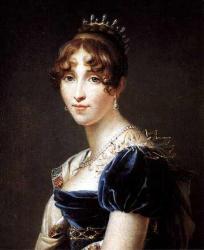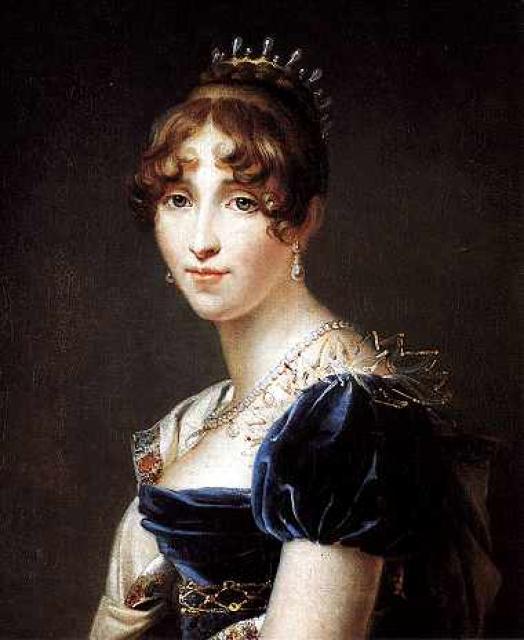
Hortense Beauharnais
 Netherlands
- Childhood and the Napoleonic Family
- Marriage and Queenship
- Music, Relationships, and Life After the Empire
Hortense de Beauharnais lived through revolution, empire, royal glamour, and exile, yet her life was never simply a story of borrowed titles. A gifted musician and artist, she became the first Queen of Holland through a family arranged marriage, raised three sons amid a fraught political household, and spent her later years building a cultured refuge in Switzerland. Her youngest son would eventually rule France as Napoleon III, but Hortense’s own story was marked as much by private grief and enforced displacement as by the Bonaparte family’s public triumphs.
Childhood and the Napoleonic Family
Hortense was born in Paris on April 10, 1783, the daughter of Alexandre, Vicomte de Beauharnais, and Marie-Josèphe-Rose Tascher de La Pagerie, later known as Joséphine. Her parents’ marriage broke down when she was very young, and her father initially questioned whether he was her father before later recognizing her. In 1788, Hortense travelled with her mother and older brother Eugène to Martinique, returning to France in 1790 as revolutionary tensions mounted.
The Revolution brought danger close to home. Alexandre was imprisoned and guillotined in 1794; Joséphine was also jailed before her release. Hortense and Eugène were spared imprisonment and cared for by family friends. In 1795 Hortense entered the girls’ school run by Madame Campan near Paris. There she studied the accomplishments expected of a young woman of her class, including music, drawing, dance, and social etiquette. Music and the fine arts became more than courtly skills: she wrote songs, played piano, and developed a lifelong interest in painting and performance.
When Joséphine married Napoleon Bonaparte in 1796, Hortense and Eugène became part of a family whose fortunes were rising with the general’s political power. Napoleon treated them with affection and later adopted them, while his ambitions made the young woman’s personal choices increasingly subject to dynastic strategy.
Marriage and Queenship
On January 4, 1802, Hortense married Louis Bonaparte, Napoleon’s younger brother. The match was arranged by Napoleon and Joséphine, who hoped it would strengthen the links between the Beauharnais and Bonaparte families. It produced three sons: Napoléon-Charles, born in 1802; Napoléon-Louis, born in 1804; and Louis-Napoléon, born in 1808. The eldest died of croup in 1807, a devastating loss for both parents. The youngest would become Napoleon III, emperor of the French.
The marriage was deeply unhappy, shaped by mistrust, jealousy, periods of separation, and the pressures of the imperial family. Louis’s health and temperament added to the strain, while Hortense often sought distance from the household and courtly duties that others expected of her. The couple’s youngest son was born amid controversy over paternity, which was contested within the family. Their relationship eventually broke down, although they never secured a formal divorce.
In 1806 Napoleon made Louis King of Holland, and Hortense became queen. She initially dreaded leaving Paris for what she imagined as a cold, damp country, but the Dutch landscape and the warm public welcome surprised her. Her time in the Netherlands was nevertheless short and politically complicated. Louis tried to govern the kingdom in the interests of its inhabitants, while Napoleon expected Holland to serve French military and economic policy. Hortense’s loyalties were caught between husband, mother, stepfather, and children; she spent much of her time away from the Dutch court. In December 1809, Napoleon refused Louis’s request for a divorce, but granted Hortense custody of the children and an allowance intended to secure her independence.
Music, Relationships, and Life After the Empire
Hortense’s artistic life flourished alongside the political drama. She composed the melody for “Partant pour la Syrie,” a romance traditionally dated to around 1807, with words by Alexandre de Laborde. The song became a popular Bonapartist emblem and was later treated as a national song during the Second Empire, when her son ruled France. Music, salons, and performance would remain central to the world she created in exile.
In the years after her marriage ended in practice, Hortense formed a relationship with Charles de Flahaut. In 1811 she gave birth to a son, Charles, whose paternity was kept quiet at the time; he later became the influential Duke of Morny. Historians identify Flahaut as the child’s father. Hortense’s life thus included a discreet personal relationship that sat uneasily beside the public expectations attached to her royal title and Bonaparte name.
After Napoleon’s first abdication in 1814, Hortense received the title Duchess of Saint-Leu and a pension from Louis XVIII. When Napoleon returned from Elba in 1815, she did not abandon her family’s cause, and after his final defeat she was treated with suspicion by the restored Bourbon government. She left France and spent years moving between places of refuge before buying Arenenberg, on Lake Constance in Switzerland, in 1817.
Arenenberg became her home and a gathering place for Bonapartists in exile. Hortense hosted visitors, composed and performed music, painted, and staged theatrical entertainments. She also wrote memoirs that preserved her own perspective on the upheavals she had witnessed. The estate was both a family refuge and a small court, where she could shape a life beyond the immediate control of Parisian politics.
Her later years brought another profound loss. In 1831 her son Napoléon-Louis became involved in the Italian uprising in Romagna and died there of measles. Hortense escaped with her youngest son, Louis-Napoléon, who survived and continued the family’s political ambitions. Hortense died at Arenenberg on October 5, 1837, aged 54. She did not live to see him become Emperor Napoleon III in 1852, but the household and Bonapartist world she maintained in exile helped keep that political legacy alive.