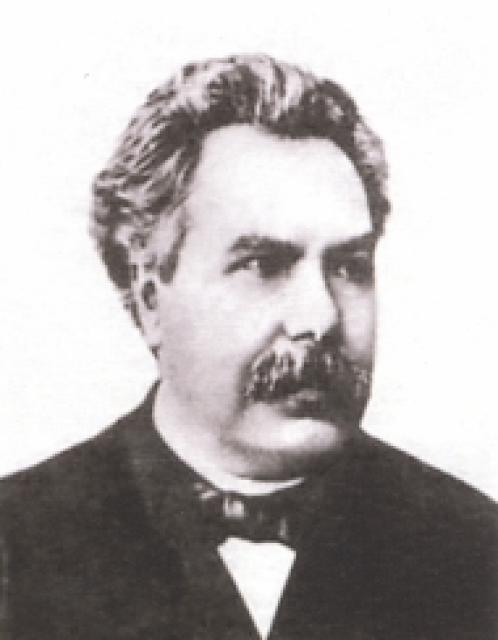
Hristofor Ledentsov
 Russia
Biography of Khristofor Ledentsov
Khristofor Semenovich Ledentsov was born on July 24, 1842, in Vologda, Russia. He came from a wealthy family of merchants - his father, Semen Alekseevich, was a prominent merchant of the first guild. His father owned a fur shop in Vologda and was involved in transportation of goods by rivers. He was also educated and served as the mayor of the city.
Ledentsov received a good education and strong work ethic from his family. In 1860, he graduated from the Vologda Provincial Gymnasium and was sent to the Moscow Practical Academy of Commerce. The academy had a high standard of education, with lectures given by professors from Moscow University. Ledentsov successfully completed his studies in 1862 and was awarded the title of Honorary Citizen.
Although he attempted to continue his education in Cambridge and even visited England to improve his language skills, family circumstances prevented him from pursuing further studies.
Ledentsov's family wealth allowed him to establish a successful business. By the beginning of the century, he owned land near Vologda, a distillery, income properties in Saint Petersburg and Vologda, and estates in Syromyatniki, Skhodnya, and Zvenigorod. Through his hard work, Ledentsov increased the family's wealth and became one of the richest merchants in Russia. He was an energetic and enterprising individual who traveled extensively in Western Europe to study various industries. He was well-educated and fluent in eight languages. In his mature years, he even attended classes at Cambridge University for a while before having to stop due to the death of his wife, S.N. Belozerova, in 1897. He generated substantial profits from trade and later from railroad stocks. By the end of the 19th century, Ledentsov had become a millionaire.
During the 1870s and 1880s, Ledentsov was an active public figure in Vologda. He served as the mayor of the city, a magistrate, and a member of the founding committee of the Vologda branch of the State Bank. Ledentsov was a generous benefactor, spending significant amounts of money on charitable causes. He was a member of the Society for Assistance to Needy Students of the Vologda Gymnasium and funded the construction of a home for the elderly in the city.
As the mayor of Vologda, Ledentsov was concerned about the "underprivileged classes" and sought to combat usury. In 1885-1886, he organized pawnshops at the city bank to provide loans. It was a challenging process to establish the pawnshop, and Ledentsov contributed his own money to make it happen. Finally, on October 25, 1888, the first municipal pawnshop in Russia was opened in Vologda.
In the mid-1890s, after the death of his wife, Ledentsov moved to Moscow. In 1897, he formulated his dream of creating a society that would promote scientific discoveries and research in natural sciences, inventions, and advancements in other fields of knowledge. What motivated him to dedicate the last ten years of his life, and eventually his entire fortune, to this vision? According to his close friend and collaborator, Professor S.A. Fedorov of Moscow University, Ledentsov was a reserved individual who was originally destined for a purely commercial profession but was deeply moved by powerful spiritual and life experiences.
Ledentsov became friends with renowned scientists, such as Professors S.A. Fedorov and N.A. Umov from Moscow University, and acquainted with N.A. Tikhomirov, N.E. Zhukovsky, and others. They assisted him in developing the charter of the society.
The primary goal of the society's organizers was not only to support Russian science but also to improve the lives of the working class. They believed that science could be a powerful force in achieving this. Ledentsov used his own financial resources to support the society's objectives, but he realized that his personal capital alone would not be sufficient. Therefore, he came up with the idea of establishing a prize for solving the problem of "achieving maximum benefit for the majority of humanity with the minimum capital."
The process of establishing the society was delayed due to various bureaucratic hurdles at the Ministry of Education and other institutions.
Due to illness, Ledentsov traveled to Switzerland for treatment. He passed away in Geneva on March 31, 1907, leaving his vast fortune to be used for the purposes of the society according to his spiritual will.
According to his will, all movable and immovable property was sold and transformed by trustees into government-guaranteed bonds, forming a special inviolable capital named after him, "Khristofor Ledentsov." This capital was transferred to the Imperial Moscow University and the Imperial Moscow Technical School.
The income from this capital, except for a small portion allocated for other purposes, was to be directed to the Society for the Promotion of Experimental Sciences and their Practical Applications, which was established by Ledentsov.
In 1909, the society was finally founded and named after Khristofor Ledentsov. Its motto became "Science. Labor. Love. Satisfaction." The opening of the society was welcomed by scientists and the progressive intelligentsia of Russia.
The annual income from Ledentsov's inviolable capital ranged from 100,000 to 200,000 rubles, which was a substantial amount during those times (Ledentsov initially donated 100,000 rubles to Moscow University during the society's establishment period).
By 1914, the total amount received from the sale of Ledentsov's property reached 1,881,230 rubles. According to Ledentsov's plan, the society's financial resources were supposed to be replenished through donations and proceeds from the implementation of inventions and other activities in which the society participated. However, even the existing capital bequeathed to the society was not fully utilized. Property sales continued until the society's closure in 1918. On May 17, 1909, the society was officially named after Khristofor Ledentsov.
On December 5, 1910, the society was publicly inaugurated. After 1917, the society's resources were utilized by the People's Commissariat of Military Affairs, and the society's patent department became the basis for the establishment of a patent office in 1918, marking the beginning of patent management in Soviet times.
On September 8, 1918, by the personal decree of Vladimir Lenin, the society was closed, and its assets and capital were nationalized.
Ledentsov's society had no precedents in Russia or abroad.
On the old Vvedenskoye Cemetery in Vologda, Ledentsov's grave is marked with a prestigious black granite monument inscribed with the following words on both sides of the base:
"Science - a means leading to possible good for humanity"
"With the minimum capital, bring maximum benefit to the majority of the population"




