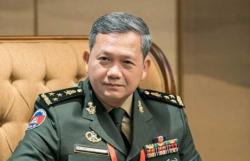
Hun Manet
 Cambodia
- Education and military career
- A carefully managed succession
- Prime minister and public image
- Legacy and challenges
Hun Manet is a Cambodian politician and former military officer who became prime minister in August 2023, succeeding his father, Hun Sen, after the ruling Cambodian People’s Party won another decisive election. Trained at West Point and later educated in economics in the United States and Britain, he spent much of his career in the Royal Cambodian Armed Forces before moving into senior government and diplomatic roles. His leadership began amid a managed generational handover that continued the dominance of his family and party.
Education and military career
Hun Manet was born in Phnom Penh on October 20, 1977, during a period of conflict and upheaval in Cambodia. He joined the Cambodian military and became the first Cambodian to graduate from the United States Military Academy at West Point, in 1999. He later earned a master’s degree in economics from New York University and a doctorate in economics from the University of Bristol.
After returning to Cambodia, he rose through the military hierarchy. His posts included counterterrorism chief, deputy commander of his father’s bodyguard unit, deputy commander-in-chief of the Royal Cambodian Armed Forces and commander of the Royal Cambodian Army. His Western education and military experience made him an unusual figure among senior Cambodian officials and helped prepare him for diplomatic engagements abroad.
A carefully managed succession
Hun Sen, who had governed Cambodia for nearly four decades, announced in 2023 that his eldest son would succeed him as prime minister. Hun Manet won a seat in the National Assembly for the first time in the July 2023 election, and the king appointed him to form a government in August. Parliament endorsed him unanimously.
The transfer took place after the Cambodian People’s Party secured 120 of the 125 seats. The main credible opposition party had been barred from participating, and Western governments and rights groups criticized the election as neither free nor fair. Hun Sen stepped down as prime minister but retained major influence as head of the CPP and later president of the Senate. Analysts described the transition as generational in personnel, while noting that political power remained concentrated among the same party and connected families.
Prime minister and public image
Hun Manet entered office promising economic development, stronger public services and continued peace and stability. His government brought in many new ministers, though numerous appointees were relatives of those they replaced. Observers have noted that he has made few major political reforms and that dissent, media independence and electoral competition remain sharply constrained in Cambodia.
He has cultivated a public style distinct from his father’s, making more use of social media and presenting a younger, internationally educated image. He has also undertaken foreign diplomacy, seeking to maintain ties with China, Cambodia’s closest major partner, while rebuilding relations with the United States and other Western governments. On a 2026 visit to Washington, he said Cambodia’s relationships with China and the United States were not mutually exclusive.
Hun Manet has also faced difficult regional issues. Following deadly clashes and a fragile ceasefire between Cambodia and Thailand, he told Reuters in 2026 that Thai forces were occupying Cambodian territory and called for a joint boundary commission to resume work. Thailand rejected the claim, saying its troop positions were part of de-escalation arrangements. The dispute has kept sovereignty and border security high on his agenda.
Legacy and challenges
Hun Manet’s premiership is closely tied to the question of continuity. His appointment marked Cambodia’s first transfer of the premiership from father to son, but it unfolded through institutions dominated by his father’s ruling party. His military résumé, academic credentials and diplomatic activity have set him apart in presentation, yet the structure of political power has changed less than the faces at its highest levels.
As prime minister, he faces pressure to manage economic development, regional tensions and international scrutiny of Cambodia’s political freedoms. His record will be judged by whether the new leadership brings meaningful changes to governance as well as a new generation of officials.