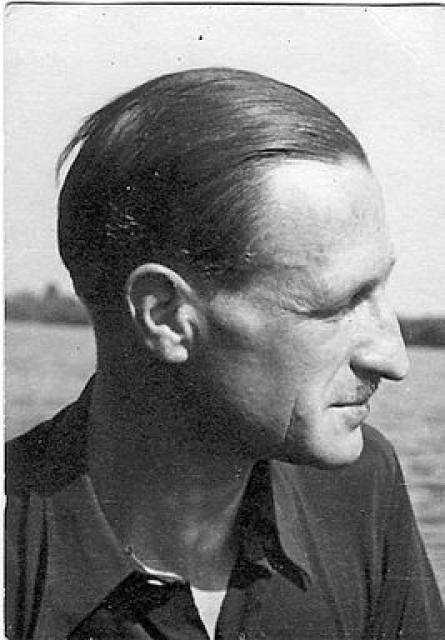
Igor Krivoshein
 France
- Early Life and Education
- World War I and Service in the Resistance
- Engineering Career and Anti-Fascist Stance
- Resistance Activities and Imprisonment
- Post-War Activities and Soviet Repatriation
Early Life and Education
Alexander Krivoshein Jr. was born in Saint Petersburg, the son of renowned statesman Alexander Krivoshein Sr. He attended the Russian Assembly Gymnasium and completed an accelerated course at the Page Corps.
World War I and Service in the Resistance
In 1916, Krivoshein became a Lieutenant in the Imperial Russian Guard Horse Artillery. He served in the reserve battery in Pavlovsk until the February Revolution in 1917. He was briefly arrested in Petrograd and taken to the Tauride Palace, but was quickly released. These events were later recounted in Aleksandr Solzhenitsyn's "March of the Seventeenth."
During World War I, Krivoshein fought on the front lines. After the Bolshevik Revolution, he worked in Savva Morozov's office in Moscow and later went into hiding in Tver where he worked under an assumed name on a railway construction project. In 1919, he crossed the front lines and joined the Volunteer Army, serving in his former battery until 1920.
Engineering Career and Anti-Fascist Stance
In 1920, Krivoshein emigrated to France with his father, where he studied physical mathematics at the Sorbonne and electrical engineering at the Higher Electrical Engineering School in Paris. He worked for various companies, including a telephone company, the "Apel" test laboratory, and the "Brothers Lemercier" factory.
Krivoshein actively supported the Russian Volunteer Union and became a member of the Russian Trade, Industry, and Finance Association. During World War II, he maintained an anti-fascist stance and was arrested in June 1941. He was held in the Compiègne camp for six weeks before being released.
Resistance Activities and Imprisonment
Krivoshein became a key figure in the Resistance, forming a committee to aid Russian prisoners in Compiègne. Along with Mother Maria Skobtsova, he helped rescue Jews from deportation to Germany. He joined the "Free Shooters" organization, gathering intelligence for General Charles de Gaulle and hiding and smuggling Allied pilots shot down over France.
In June 1944, Krivoshein was arrested and tortured. He was sentenced to life imprisonment and served time in Buchenwald and Dachau. He endured hard labor and illness before being liberated by American forces in May 1945. He was awarded the Medal of Resistance.
Post-War Activities and Soviet Repatriation
After World War II, Krivoshein actively participated in public life. He became a staunch Soviet patriot, adopted Soviet citizenship, and supported the return of Russian émigrés to the USSR. From 1945 to 1947, he chaired the Commonwealth of Russian Volunteers, Partisans, and Resistance Participants. He was also a founder of the "Russian Aid" society, which provided social support to émigrés.
On November 25, 1947, Krivoshein was arrested and deported from France along with other Soviet citizens. He spent time in the Soviet occupation zone of Germany before being repatriated to the Soviet Union.



