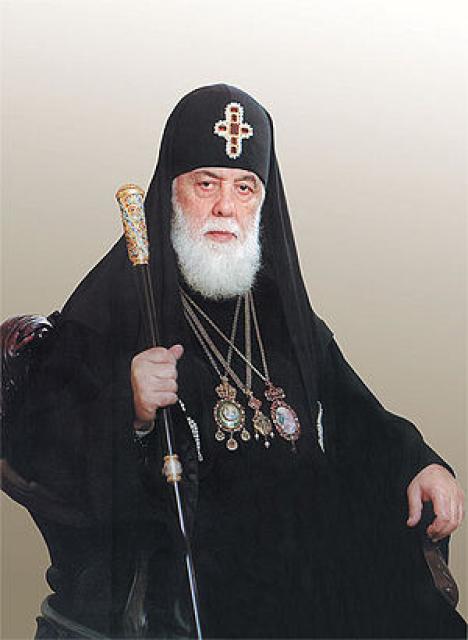
Ilia II
 Georgia
- Biography of Ilia II, Catholicos-Patriarch of All Georgia
- Early Life and Education
- Leadership Roles
- Role in Georgian History
- Current Activities and Initiatives
Biography of Ilia II, Catholicos-Patriarch of All Georgia
Ilia II, the Catholicos-Patriarch of All Georgia, is the spiritual leader and head of the Georgian Orthodox Church. He was born as Irakli Georgievich Ghudushauri-Shiolashvili on January 4, 1933, in Vladikavkaz, Russia. Ilia II comes from an influential Georgian noble family with ties to the former royal dynasty of Bagrationi.
Early Life and Education
Ilia II completed his education at the Moscow clerical seminary and was ordained as a monk in 1959. He returned to Georgia and served as a priest at the Batumi Cathedral Church. In 1961, he was appointed as an igumen (abbot) and later became an archimandrite. In 1963, Ilia II was elected as the bishop of Batumi and Shemokmedi and appointed as the Patriarchal Vicar.

Leadership Roles
During his early years as a bishop, Ilia II also served as the first rector of the Mtskheta Theological Seminary, the only theological institution in Georgia at the time. He was elevated to the rank of Metropolitan in 1969. After the death of Patriarch David V in November 1977, Ilia II was elected as the new Catholicos-Patriarch of All Georgia on December 25, 1977.

Under Ilia II's leadership, the Georgian Orthodox Church, once suppressed by Soviet ideology, was able to regain its influence and prestige by the late 1980s. By 1988, there were approximately 180 priests, 40 monks, and 15 nuns to meet the needs of the estimated one to three million believers in Georgia. The Church had around 200 functioning churches, one seminary, three women's monasteries, and four men's monasteries.
Role in Georgian History
During the final years of the Soviet Union, Ilia II actively participated in Georgia's public life. He joined the demonstrators in Tbilisi protesting against Soviet rule on April 9, 1989, and attempted to mediate between the protesters and the Soviet forces to prevent bloodshed. Tragically, the peaceful demonstration was dispersed by Soviet troops, resulting in the death of 22 people and hundreds injured.
During the Georgian Civil War, Ilia II called for peaceful solutions to the crisis between the warring factions. From 1978 to 1983, he was one of the presidents of the World Council of Churches (WCC), an ecumenical organization of the Georgian Orthodox Church. In May 1997, the Holy Synod of the Georgian Orthodox Church announced its withdrawal from the WCC.
Current Activities and Initiatives
Ilia II is an advocate for constitutional monarchy as the best form of government for Georgia. In October 2007, he publicly called for considering the establishment of a constitutional monarchy under the rule of the Bagrationi dynasty, which lost its crown in the early 19th century. This statement came during a period of growing confrontation between President Mikheil Saakashvili's government and the opposition, with many opposition members welcoming the Patriarch's proposal.
During the Russo-Georgian War in August 2008, Ilia II appealed to the political leadership of Russia and the Russian Orthodox Church. He also made pastoral visits, providing food and medical assistance to the occupied Georgian city of Gori and surrounding settlements on the verge of a humanitarian catastrophe. Ilia II played a crucial role in facilitating the repatriation of the bodies of deceased Georgian soldiers and civilians to their families.
Due to declining birth rates in Georgia, Ilia II personally offers baptism to any child in families with two or more children. He conducts mass baptism ceremonies four times a year, attracting thousands of participants.
Overall, Ilia II has been a prominent figure in the religious, social, and political life of Georgia, working towards the preservation and revival of the Georgian Orthodox Church and the well-being of the Georgian people.