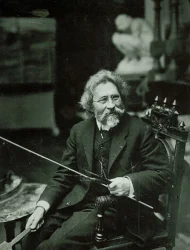
Ilya Repin
- From Chuhuiv to the Academy
- The Wanderers and a National Style
- A Life Across Borders
- A Painter of People and Power
Ilya Repin gave the people and tensions of the Russian Empire a vivid presence on canvas. A master of realism and one of the leading artists of the Peredvizhniki, or Wanderers, he painted laborers, crowds, political scenes and intensely observed portraits. Born in what is now Ukraine, he drew on both Ukrainian and Russian histories and spent his final years in Finland, outside the Soviet Union.
From Chuhuiv to the Academy
Repin was born on 5 August 1844 in Chuhuiv, in the Kharkiv region of what is now Ukraine, then part of the Russian Empire. His family had limited means, and he began his artistic training in a local workshop painting icons. In 1863 he traveled to St Petersburg and entered the Imperial Academy of Arts, where he studied history painting and developed the technical skill that would underpin his large canvases.
His breakthrough came with Barge Haulers on the Volga, completed in 1873. The painting shows a line of laborers dragging a vessel along the riverbank, their faces and postures rendered with close attention. It made physical hardship and class inequality impossible to overlook, while giving each figure an individual presence. The work brought Repin recognition and established him as a leading realist.
The Wanderers and a National Style
Repin joined the Peredvizhniki, a group of artists who organized traveling exhibitions beyond the academy’s official circles. The Wanderers sought subjects drawn from contemporary life, social conditions and national history. Repin’s work fit that ambition while reaching a scale and emotional range that won admirers across the empire.
Religious Procession in Kursk Province portrays a mass pilgrimage as a layered social scene, with peasants, clergy, police and officials gathered in a dusty procession. Reply of the Zaporozhian Cossacks to the Sultan of the Ottoman Empire revisits an episode of Cossack history through a tumultuous, comic gathering around a letter. Both paintings demonstrate his gift for crowd scenes: individual expressions and gestures build into a larger portrait of society.
Repin also became one of the era’s foremost portraitists. He painted writers, composers, scientists and public figures, including Leo Tolstoy and the composer Modest Mussorgsky. His portraits were admired for their psychological immediacy and for the way he captured not only a sitter’s appearance but also their temperament.
A Life Across Borders
By the late nineteenth century, Repin was a celebrated artist and teacher. He served at the Imperial Academy and continued to work on historical and contemporary subjects. In the 1890s he painted They Did Not Expect Him, a domestic scene of a political exile returning to his family, and Ivan the Terrible and His Son Ivan, a powerful and unsettling image of violence within the royal household.
From the turn of the century, Repin lived at Penaty, his home in Kuokkala, near St Petersburg. The Russian Revolution and Finland’s independence changed the political landscape around him; without moving, he found himself living in a new country. He remained in Finland rather than returning to Soviet Russia, while Soviet authorities later claimed his work as part of the national artistic heritage. Repin died at Penaty on 29 September 1930.
A Painter of People and Power
Repin’s work endures because it combines technical command with a keen sense of human presence. He could make a monumental historical scene feel intimate and a portrait feel like a revealing encounter. His life and legacy cross modern national boundaries, but his paintings remain rooted in the varied communities, histories and social conflicts of the Russian Empire.