(Ioann XXII) Andjelo Djuzeppe Ronkally
 Italy
Italy- Pope John XXIII - A Biography
- The Catholic Church
- A New Era
- The Motto of Pope John XXIII
- The Second Vatican Council
- Pope John XXIII's Predecessors
- The Era of Dialogue
- The Need for Change
- Challenges
- Modernizing the Church
- A Humble Background
Pope John XXIII - A Biography
The Papal TitleThe full title of the Pope is the Bishop of Rome, the Vicar of Jesus Christ, the Successor of the Prince of the Apostles, the Supreme Pontiff of the Universal Church, the Patriarch of the West, the Primate of Italy, the Archbishop and Metropolitan of the Roman Province, the Monarch of the State of Vatican City, and the Servant of the Servants of God. Each Pope chooses his own title. Pope John XXIII was the 262nd Pope in the history of the Catholic Church.
The Catholic Church
The Catholic Church is one of the oldest institutions on Earth, with Christianity in its Catholic form being the personal history of Europeans. It is divided into events before and after the birth of Christ. The Pope is the head of the Catholic Church, but what does he represent for Orthodox Christians, Buddhists, Muslims, and Jews?
A New Era
In the 21st century, when progressive intellectuals proudly proclaim that they believe in an Absolute that transcends all religions, is the existence of a religious organization with a two-thousand-year history an anachronism? Perhaps not, if it modernizes. However, not for the sake of the public, by replacing altars with football gates, but by moving forward and reinterpreting the eternal spiritual values once proclaimed by Christ. As one reaches the middle of life, the hull of momentary passions begins to fade, and one desires to make everyone live "righteously." The time of "witch hunts" and imposing one's beliefs "by fire and sword" passes. Wisdom comes.
The Motto of Pope John XXIII
The motto of Pope John XXIII was "Do not be afraid!" These words were addressed to those who had lost faith in human dignity, urging them not to be afraid to be holy in life, not to be afraid to do good. No one needs to be retrained or forced to live a righteous life. Instead, one can try to live according to the commandments of Christ. The position of the Church, through its highest pastor, differs greatly from the centuries-old practice when the number of converts to the true faith was one of the main indicators. At some point in history, a radical shift towards new values had to occur.
The Second Vatican Council
This shift happened at the Second Vatican Council, convened by Pope John XXIII in 1962. It can be said with certainty that the history of the Catholic Church since the Reformation is divided into events before and after the Second Vatican Council. Before the Council, there seemed to be no prospects for development, but after it, there was hope. The movement towards the Second Vatican Council began during the pontificate of Pope Pius IX, who convened the First Vatican Council in 1869. Its main outcome was the acceptance of the dogma of papal infallibility. Marxists had a field day with this dogma. However, it seems that things are not that simple. Immunity under the guise of infallibility is only necessary for a reformer who fears opposition to his endeavors. If everything is going smoothly, according to precedent, infallibility is not needed.
Pope John XXIII's Predecessors
Pope Pius IX is known as the creator of modern papacy. His predecessor considered gas lamps and railways to be the devil's inventions. Pope Pius IX established banks and joint-stock companies. Under his rule, numerous Catholic journals and newspapers began to be published. At the same time, the Vatican found itself face to face with a new world in which the labor movement and national liberation struggles had an increasing influence, and where scientific and technological progress was advancing by leaps and bounds. This new reality could not be addressed through curses, excommunications, and prohibitions.
The Era of Dialogue
The old formula, "Rome has spoken, the matter is settled," had exhausted itself. The time for monologue addressed to "the city and the world" had passed. The era of dialogue had arrived. All subsequent popes, willingly or unwillingly, were forced to seek compromises. Leo XIII, nicknamed "the great pope of the workers," dealt with this, issuing the encyclical "Rerum Novarum" in 1891, which is considered one of the most important "social" encyclicals. Benedict XV was called the "Apostle of Peace" for his neutrality during World War I. Pius XI formally "reconciled" with the Italian government, appearing on the balcony overlooking St. Peter's Square on the day of his coronation. Pius XII issued the encyclical "Humani Generis" in 1950, which revisited the relationship between science and faith. In 1952, he sent an apostolic message to the people of Russia, calling for a renunciation of communism.
The Need for Change
Some of the encyclicals and messages were utopian, while others failed to provide answers to pressing questions. However, the mere fact of their existence was significant. The Vatican was not indifferent to the life that was bustling beyond St. Peter's Square. The era of isolation in which the Catholic Church found itself was coming to an end. Despite the goodwill and efforts made to establish dialogue, the number of unresolved problems (both within the Church and between different faiths) did not decrease.
Challenges
The problems arose from the revolutions that had shaken many Catholic countries. Tense relations were particularly prevalent with Mexico, Colombia, Paraguay, Venezuela, and Argentina, where the Church was separated from the state. The Vatican perceived this as an insult and severed ties with these countries.
Modernizing the Church
An increasing number of priests and lay people were demanding modernization of Catholic doctrine to align it with the worldview of the 20th century. The first conflict on this issue arose in the late 19th century in the United States, where the Catholic organization "Knights of Columbus" was created. The Catholic Church in the United States pursued a path of capitalist development and the associated scientific and technological progress. At the same time, it considered Protestant churches to be its natural allies.
"The heresy of Americanism" was condemned by the Vatican, but at the same time, the Catholic Church in the United States was allowed a more flexible policy than before.
In the early 20th century, a similar problem, but on an even larger scale, emerged in France, where a new heresy called "modernism" was declared. Modernists, including both priests and lay people, advocated for reform and called for the Church to engage in dialogue with public thought and science.
The heresy of modernism was pronounced anathema. Since then, relations between the Vatican and the Church in France have become quite tense. In 1906, the problem escalated further with the rupture of relations with Paris in response to the separation of the Church from the state.
Another problem was the Vatican's attitude towards communism. Communists were excommunicated from the Church in 1949. Thus, a significant number of people who were "charmed" by communism but had no connection to atheism left. For many of them, Jesus Christ was their first communist.
The Church also faced challenges from within its own flock. Conversations based on prohibitions and good advice only led to non-acceptance and rejection. The texts of the encyclicals bore a striking resemblance to the materials of another congress of the Communist Party, particularly in terms of building a bright future and the ideological image of the builder.
In this way, the Catholic Church was losing people who were accustomed to thinking independently and making their own choices. Statistics showed a decrease in the number of Catholics and an increase in the number of priests who renounced their orders. In 1958, Pope Pius XII passed away. The main contenders for the holy throne were his closest collaborator and two liberal reformers. However, one of them was too young, and the other too arrogant.
Thus, the election happened exactly according to the saying: "He who enters the conclave as Pope, leaves it as a Cardinal." After eleven rounds of voting, the victory was won by the 76-year-old Patriarch of Venice, Roncalli, the "dark horse" whose candidacy was not initially taken seriously.
A Humble Background
On the path to the Vatican, a son of a peasant was replacing a series of aristocratic Popes. And he chose a name for himself that was very common - Giovanni (John).
Usually, the name symbolizes a spiritual connection with the predecessor whose policies the Pope wants to continue. In this case, the precedent did not work: the last Pope named John was the Neapolitan pirate and brigand Balthasar Cossa, who briefly occupied the papal throne in the 15th century and was later declared an antipope. It is more likely that John XXIII wanted to demonstrate a formal break with his predecessors - aristocrats with names like Pius, Leo, and Benedict.
Giovanni wanted to become a servant of the servants of God not only in title but also in practice. This had been his life's journey.
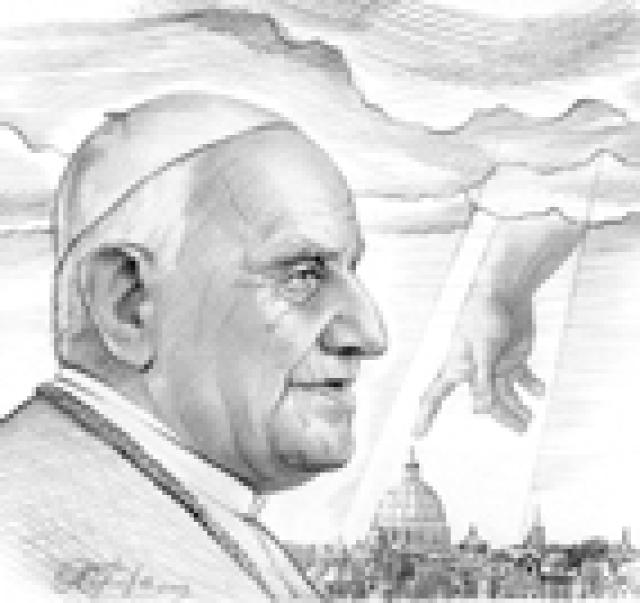
Angelo Giuseppe Roncalli was born in 1881 in a mountain village near Bergamo. He was the fourth child in a peasant family of thirteen children. Typically, in such families, at least one child was dedicated to God, resulting in one less mouth to feed and a family member to "pray away" sins.
After graduating from the seminary and being ordained as a priest, the young cleric became the secretary to the Bishop of Bergamo, who was considered a dangerous liberal. During World War I, Roncalli served as a medic and then as a chaplain in a military hospital.
With the coronation of Benedict XV, Roncalli's fortunes improved. He was entrusted with creating a missionary organization and later appointed its president. But in 1925, Pope Pius XI sent Roncalli into an honorary exile as the diplomatic representative of the Vatican in Bulgaria. He then served in Greece and Turkey in 1935.
In Sofia, Bishop Roncalli did not live up to the expectations placed upon him. However, those expectations were utopian. At that time, a dynastic marriage took place between the Bulgarian King Boris and the Austrian Archduchess Iolanta. The Vatican hoped that this marriage would lead to closer ties between Bulgaria, Italy, and the Vatican. The Holy See anticipated the great work ahead in converting the local Orthodox population to the true faith.
Hopes were based on the required reports of the catholization of "pagans" (which for a long time included Orthodox believers de facto). The previous 80 years of "work" with Russia were conducted based on the principle of "who outsmarts whom." The heroic efforts from that period left behind verses by A.K. Tolstoy: "The eunuchs rebelled. They enter the Pope's chambers..." and immortal lines by Ilf and Petrov about capturing the tender soul of Kozlevich by the priests Kushakovskiy and Moroshek.
Bishop Roncalli clearly realized the impossibility of accomplishing the assigned task. It is hard to say whether he was deeply affected by the loss of Vatican favor when he was "forgotten" in the Balkans for a whole 19 years. During the German occupation of Greece, he did not hide his sympathy for the Allies. He facilitated communication between prisoners in concentration camps and their families, saving many Jews by issuing them "transit visas" on behalf of the diplomatic mission.
From his two decades of service in the Balkans, Roncalli took away one important lesson: the time of dividing people into sheep and goats was coming to an end. The era of mercy and religious tolerance was dawning.
The Balkans also served as a valuable experience for the future Pope. He emerged untarnished by collaboration with fascism, while the Roman Curia and Pope Pius XI, charmed by the Lateran Treaties with Mussolini, deliberated for a long time on which side would be more advantageous to be on.
Eventually, the Balkan exile had to come to an end. In 1944, Roncalli was appointed Papal Nuncio to Paris. His predecessor had been declared persona non grata for collaborating with the Vichy regime. De Gaulle demanded that the Papal throne strip 33 French bishops, who had been implicated in collaborationism, of their titles and positions. It was up to Nuncio Roncalli, who had become a cardinal by this time, to deal with all of this.
Finally, the penultimate step toward the Vatican was taken in 1953 with Roncalli's appointment as the Patriarch of Venice. In his first sermon, the patriarch outlined his creed: "Providence led me from my native village and sent me wandering along the roads of the West and the East, encountering people of various beliefs and ideologies, familiarizing myself with acute and threatening social problems, while at the same time allowing me to maintain composure and objectivity in studying and evaluating these phenomena. Firmly adhering to the principles of the Catholic faith and morality, I have always been more concerned with what unites than with what divides and generates contradictions." John XXIII was chosen as a compromise Pope, and no one hid this fact. The Curia hoped that during the short reign of John XXIII (he was already well over 70), liberals (progressives) and integrist (traditionalist) factions would reach an agreement, after which a new, "real" Pope would be chosen.
These hopes of the Curia were not fulfilled. Within 90 days of his election, Pope John XXIII had a conversation with one of his ministers. The Pope expressed his intention to convene an Ecumenical Council, to which the cardinal objected, saying that it would be impossible to prepare for it in 1963. The Pope responded, "Alright, we will convene it in 1962."
Giovanni turned out to be not so simple; he had a voice of his own. He obeyed the words of God, heard during prayer, and no one could persuade him otherwise.
The First Vatican Council was formally not completed, but rather postponed indefinitely. However, it made no sense to start transformations within the framework of the First Vatican Council, which was convened in the mid-19th century to address problems that were a century old. Therefore, a special apostolic constitution was issued, declaring the completion of the First Vatican Council and the convocation of the Second Vatican Council.
The goals were twofold: to adapt the Church to the modern world and to reunite with the separated Christians, referred to for the first time as brothers. These two goals comprised the program of aggiornamento, formulated and proclaimed in June 1959.
The essence of the renewal was expressed by the Pope simply and metaphorically: the two-thousand-year-old cathedral council had fallen behind the times, and the windows needed to be opened wider. A familiar image, isn't it?
The Curia vehemently opposed the convocation of the council - the Vatican's cabinet of ministers, which effectively governed the Church and had much to lose.
Support for the renewal came primarily from foreign hierarchs, especially those from "third world" countries. And their support was significant. In fact, during the conclave that elected Cardinal Roncalli as Pope, Italians were a minority for the first time in many centuries - 17 cardinals out of 52 present.
Perhaps it was because of this that the Pope was able to bring the matter to the convocation of the council. No one among the Curia cardinals took him seriously until the last moment. To everyone, he was a peculiar old man, a simple country priest who disliked fuss and pomp.
He abolished the traditional prostration and kissing of the "fisherman's ring," ordered the removal of the elaborate expressions such as "deeply venerated lips" and "most reverent steps" from the lexicon of the Vatican's official newspaper, "Osservatore Romano." Instead, he proposed writing simply: the Pope said, the Pope did, the Pope went.
He even walked around the Vatican without his entourage, visited workshops, and had a glass of wine with the workers. When he was told that he should not walk around the city so freely due to his fragile health, he replied, "So many people die on the streets. Nothing terrible will happen if the Pope dies on the street." He especially amazed