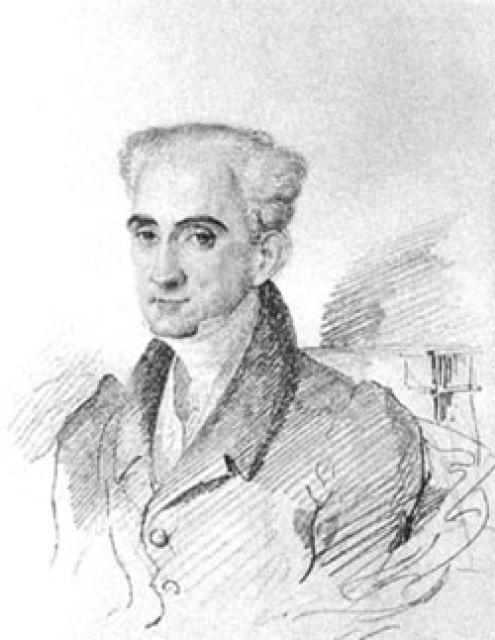
Ioannis Kapodostriya
 Greece
Biography of Ioannis Kapodistrias
Ioannis (or Ioannis Antonios) Kapodistrias was a Greek and Russian statesman and diplomat. He was born on January 31 (February 11), 1776, into an ancient Greek aristocratic family on the island of Corfu. After studying medicine and political science, law, and philosophy in Padua and other cities in Italy, Kapodistrias returned to his hometown and practiced medicine for a while before dedicating himself fully to politics.
In 1803-1806, he held an important position as Secretary of State for the Republic of the Seven United Islands, the first independent Greek state in the Ionian Islands. During this time, Kapodistrias collaborated with the Russian representative, G.D. Mochengos, on the islands. His work as a young politician was recognized in St. Petersburg.
After the transfer of the Ionian Islands to France under the Treaty of Tilsit in 1807, Kapodistrias received an invitation to join the Russian service. Initially, his career in Russia did not seem promising, as he sought a position that would bring him closer to his homeland and family. However, he eventually became a secretary at the Russian embassy in Vienna and later served as the head of the diplomatic chancellery of Admiral P.V. Chichagov during the Russian-Turkish War.
Kapodistrias gained the trust and respect of the famous Russian general M.B. Barclay de Tolly. In 1815, he played a significant role in the negotiations for the Second Paris Peace Treaty, which softened the initial harsh conditions imposed on France by the Allies.
In 1816, Kapodistrias became the co-head (together with K.V. Nesselrode) of the Russian Foreign Ministry. He was highly valued for his diplomatic abilities and served as a trusted advisor to Emperor Alexander I. Kapodistrias played a crucial role in the Congress of Vienna, where he skillfully negotiated and implemented the Tsar's program for post-war Europe.
In addition to his diplomatic career, Kapodistrias was known for his support of education and the arts. He was a member of the literary circle "Arzamas," which included famous Russian poets A.S. Pushkin and V.A. Zhukovsky. He was also elected as a member of the St. Petersburg Academy of Sciences.
Despite his achievements and influence, Kapodistrias faced challenges in implementing his vision for the Eastern Question, particularly regarding the Balkans. His proposal for the creation of independent states in Serbia, Wallachia, Moldavia, and Greece under the joint protection of the great powers was rejected by Emperor Alexander I, who feared it would lead to war and compromise the stability of the Holy Alliance.
In 1821, a revolution broke out in Greece, led by Alexander Ypsilantis. Kapodistrias, who was responsible for Greek affairs in the Russian government, condemned the uprising and expressed his commitment to maintaining peace among the Ottoman Empire's Christian subjects. This position further strengthened the suspicions of Emperor Alexander I, who believed that Kapodistrias had failed in his duty to prevent the Greek revolt.
In March 1821, Kapodistrias received a letter from Ypsilantis, calling for the expulsion of the Turks from Europe and asking for his support as the liberator of Greece. He officially condemned the Greek uprising, aligning himself with the emperor's position. However, his response was not well-received by the Greek revolutionaries, who viewed Kapodistrias as a traitor to the Greek cause.
Despite the challenges he faced, Kapodistrias continued to serve as a trusted advisor to the emperor and as a statesman. His diplomatic skills and dedication to his work were recognized and appreciated by many, but his career was ultimately cut short when he fell victim to a conspiracy in 1831.
Ioannis Kapodistrias left a lasting legacy as a Greek and Russian statesman who dedicated his life to diplomacy and political service. His vision for the future of Greece and the Balkans continues to shape the region's history to this day.