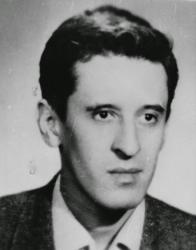
Ionatan Ratosh
 Israel
- Early Life and Education
- Literary Career and Pseudonym
- Revisionist Zionism
- Disillusionment and the "Canaanite Movement"
- Return to Israel and "Alef"
- Post-Independence and Legacy
Early Life and Education
Uziel Shelah, better known by his pen name Yonatan Ratosh, was born in 1908 in the Russian Empire to a Zionist family. His father, Yehiel, was a profound scholar of Jewish culture who raised Uziel and his half-brothers (including linguist Uzzi Ornan) on the Hebrew language. In 1921, Uziel immigrated to the British Mandate of Palestine to study at the Hebrew University of Jerusalem.
Literary Career and Pseudonym
Adopting the pseudonym Yonatan Ratosh, Uziel began writing poetry that challenged established stylistic, linguistic, and cultural conventions. His poems were described as "tearing apart" ("rish") these boundaries.
Revisionist Zionism
In the late 1920s, Ratosh became involved in the Revisionist Zionist movement, using his real surname Alperin. He aligned himself with Eliyahu Bet Zuri and Avraham Stern. As a skilled writer, Alperin became the editor of the official Revisionist Zionist journal, "Ba'Herut" ("By the Sword").
Disillusionment and the "Canaanite Movement"
Alperin's radical political views led to his demotion by Ze'ev Jabotinsky in 1937. Disillusioned with the Revisionist movement, Ratosh traveled to Paris to reunite with another Irgun comrade who had become disillusioned, the Semitic philologist Adia Gurvich.
Together, Alperin and Gurvich developed the idea of a "new Hebrew consciousness," combining their previous political beliefs with a reinterpretation of history. They argued that the Israeli nation was only part of a larger Jewish civilization, united by their Canaanite language and origins.
Return to Israel and "Alef"
With the outbreak of World War II, Gurvich traveled to the United States and Alperin returned to Palestine, where he began writing for the newspaper "Ha'aretz" using the name Ratosh. In a seminal article published in 1943 titled "Ketav el ha-Noar ha-Ivri" ("Letter to the Hebrew Youth"), Alperin-Ratosh expounded his new views to Hebrew-speaking readers. The article, along with others, called for Israeli society to reconnect with the broader Jewish civilization beyond its narrow national confines.
A section of the Sabra and immigrant population embraced these ideas, disillusioned by the Holocaust and feeling disconnected from world Jewry. This group, mostly young Jewish men, came to be known as the "Canaanite Group," a term coined ironically by the editor of "Ha'aretz," Avraham Shlonsky.
In an attempt to rally support for their cause, Ratosh founded the journal "Alef" in 1950. The journal lasted for only a few years, but the Canaanite movement nevertheless left a lasting impact on Israeli culture.
Post-Independence and Legacy
Ratosh continued to publish poetry and briefly became a mentor for Israeli ideology after the Six-Day War, advocating for a secular post-Zionist state. He died in 1981, leaving behind a legacy that includes renowned sons such as mathematician and Nobel laureate Saharon Shelah. His grandson, Oz Shelah, is an Israeli intellectual and author of the website oznik.com.