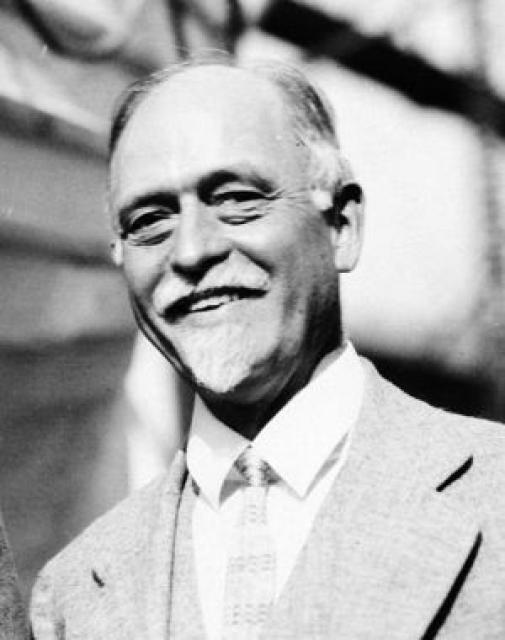
Irving Fisher
 USA
USABiography of Irving Fisher
Irving Fisher was an American economist, advocate for a healthy lifestyle, and a strong supporter of eugenics. His work on the quantity theory of money led to the establishment of the economic school of thought known as "monetarism". Renowned economist and Nobel Memorial Prize laureate, Milton Friedman, referred to Fisher as the "greatest economist ever produced in the United States". Fisher's name is associated with the Fisher Equation, Fisher's hypothesis, the Fisher effect, and the Fisher separation theorem. He was one of the earliest American neoclassical economists, although his later work on debt deflation is often considered part of the post-Keynesian school. Despite being one of the first economists to step out of the shadow of academia and achieve celebrity status, Fisher's public statements damaged his reputation irreparably. For instance, shortly before the Wall Street crash in 1929, Fisher claimed that the stock market had reached its plateau and was safe. His subsequent theories on debt deflation were largely ignored in favor of the works of John Maynard Keynes. However, in the late 1950s, long after Fisher's death, his works regained popularity, significantly restoring his professional reputation. Another resurgence of interest in debt deflation theory occurred just a few years ago due to a new global crisis.
Early Life and Education
Irving Fisher was born on February 27, 1867, in Saugerties, New York. His father was a teacher and a Congregationalist minister who instilled in his son the belief that one should contribute to society. As a child, Irving Fisher showed remarkable aptitude for mathematics and a propensity for invention. Just a week after being admitted to Yale College, his father passed away from tuberculosis at the age of 53. Despite this tragedy, young Fisher took up tutoring to support both himself and his mother and younger brother. He graduated from Yale in 1888, becoming a member of the prestigious Skull and Bones society. In 1889, a year after Yale College became a university, Fisher received his Bachelor's degree.
Academic and Professional Career
While Fisher's primary interest was mathematics, economics better suited his desire to serve society. He wrote a doctoral dissertation on mathematical economics, bridging both fields. At the age of 24, Fisher earned his first doctoral degree from Yale in 1891, under the guidance of physicist Willard Gibbs and economist William Graham Sumner. Initially, Fisher was unaware of existing European works on mathematical economics, but he acknowledged them in his dissertation. He furthered his studies in Berlin and Paris. In 1890, Irving Fisher began teaching at Yale University, eventually becoming a professor of political economy and an endowed professor in 1935. From 1896 to 1910, Fisher served as the editor of the Yale Review and actively participated in numerous scientific societies, institutes, and charitable organizations. He was a major proponent of econometrics during its historical development. As for his interests outside of economics, Fisher was particularly devoted to advocating sobriety, eugenics, public health, and world peace. He was awarded a prize by the New York Medical Society for inventing a tent for tuberculosis treatment. Tuberculosis had claimed the life of his father and nearly took his own. Fisher spent three years in sanatoriums before returning to work with even greater energy. In the 1920s, Irving Fisher fervently supported the idea of Prohibition. Additionally, he was a prolific writer and journalist, producing numerous technical books and articles. He was interested in World War I, the prosperity of the 1920s, and the subsequent Great Depression of the 1930s.
Legacy and Death
Irving Fisher passed away on April 29, 1947, in New York City at the age of 80. His contributions to economics, particularly his work on the quantity theory of money, have had a lasting impact on the field. Despite the controversies surrounding some of his public statements, Fisher's ideas and theories continue to be studied and debated by economists worldwide.