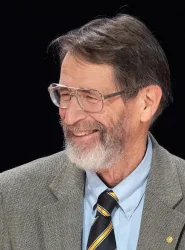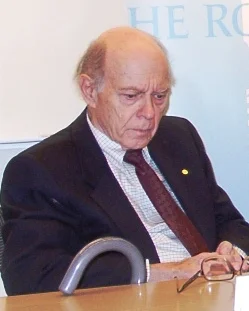
Irwin Rose
Irwin Rose, known to many colleagues as “Ernie,” spent his career asking how cells dispose of proteins they no longer need. At a time when many researchers focused on how proteins were made, Rose became fascinated by how they were broken down. His collaborative work on the ubiquitin system transformed cell biology and earned him a share of the 2004 Nobel Prize in Chemistry.
Early Life and Scientific Training
Rose was born in Brooklyn, New York, on July 16, 1926. He became interested in science as a teenager while living in Spokane, Washington. After serving in the U.S. Navy during the Second World War, he enrolled at the University of Chicago, where he earned a bachelor’s degree in 1948 and a doctorate in biochemistry in 1952.
Rose developed a reputation as a talented enzymologist, a scientist who studies the molecules that drive chemical reactions in living systems. He joined the faculty at Yale School of Medicine in 1954, researching how enzymes work and how their activity can be measured. In 1963, he moved to the Fox Chase Cancer Center in Philadelphia, where he spent most of his research career.
The Mystery of Protein Breakdown
Cells continually build and dismantle proteins. This turnover is essential: damaged or unnecessary proteins must be removed, and the raw materials can be reused. In the 1970s, Rose began collaborating with Avram Hershko, who visited his Fox Chase laboratory, and Aaron Ciechanover, Hershko’s graduate student.
Their experiments revealed that the cell uses a small protein, later named ubiquitin because it is found throughout living organisms, to mark other proteins for destruction. Through a series of biochemical steps that require energy, ubiquitin molecules attach to a target protein. The tag directs that protein to the cell’s degradation machinery, where it is broken into smaller components.
The discovery challenged the prevailing view that protein breakdown was largely nonspecific. It showed instead that cells could regulate the process with precision, controlling which proteins were removed and when. This system helps regulate vital functions including cell division, DNA repair, and immune responses. Malfunctions in protein degradation have since been linked to a range of diseases, including cancer.
Nobel Recognition
Rose, Hershko, and Ciechanover shared the 2004 Nobel Prize in Chemistry for discovering ubiquitin-mediated protein degradation. The award recognized years of collaborative experimentation that revealed a fundamental process operating inside cells. Their findings helped open new paths in medical research and contributed to the development of treatments that target the protein degradation system.
The Nobel spotlight was not what drew Rose to science. Colleagues remembered him as an energetic mentor who delighted in solving difficult biochemical puzzles and encouraging researchers to pursue unexpected questions. His career was built around curiosity and collaboration rather than public acclaim.
Legacy
Rose continued working in biochemistry well into his later years and maintained connections with the scientific community after retiring from Fox Chase. He died on June 2, 2015, at the age of 88.
His work changed how scientists understand the life cycle of proteins. By showing that cells can label selected proteins for controlled destruction, Rose and his collaborators revealed a hidden layer of biological regulation. The discovery remains central to modern cell biology and stands as a testament to the power of asking what happens after a cell has made a protein.