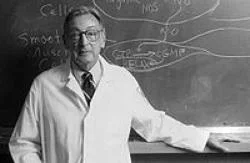
Rodney Robert Porter
Rodney Robert Porter was a British biochemist whose research revealed key details of antibody structure. His work helped explain how the immune system recognizes and binds foreign substances. In 1972, he shared the Nobel Prize in Physiology or Medicine with Gerald Edelman for discoveries concerning the chemical structure of antibodies.
Education and Wartime Service
Porter was born on October 8, 1917, in Newton-le-Willows, Lancashire. He studied at the University of Liverpool, graduating in 1939, and served in the Royal Army Service Corps during the Second World War. He took part in the Allied campaigns in North Africa and Italy. After the war, he went to Cambridge, where he became the first doctoral student supervised by Frederick Sanger and completed his PhD in 1948.
Research on Antibodies
Porter joined the National Institute for Medical Research at Mill Hill in 1949. There he developed methods for studying proteins in blood and became deeply involved in immunochemistry. A key breakthrough came when he used the enzyme papain to split antibody molecules into fragments. Two fragments retained the ability to bind antigens, while another formed the remaining portion of the molecule.
This work helped establish that antibodies are built from four protein chains: two larger heavy chains and two smaller light chains. Porter’s findings complemented Edelman’s independent research, which used a different approach to examine antibody structure. Together their discoveries made it possible to understand how antibody molecules combine structural stability with the ability to recognize many different targets.
Academic Leadership and Later Work
Porter became professor of immunology at St Mary’s Hospital Medical School in London in 1960 and moved to Oxford in 1967 as Whitley Professor of Biochemistry. He led research into complement, a group of proteins that works with antibodies in immune defense. His laboratory trained scientists who went on to contribute to immunology and biochemistry.
Porter died in a road accident on September 6, 1985, shortly before his planned retirement. His legacy includes not only the Nobel-recognized discoveries but also the experimental methods and research community that helped transform immunology into a molecular science.