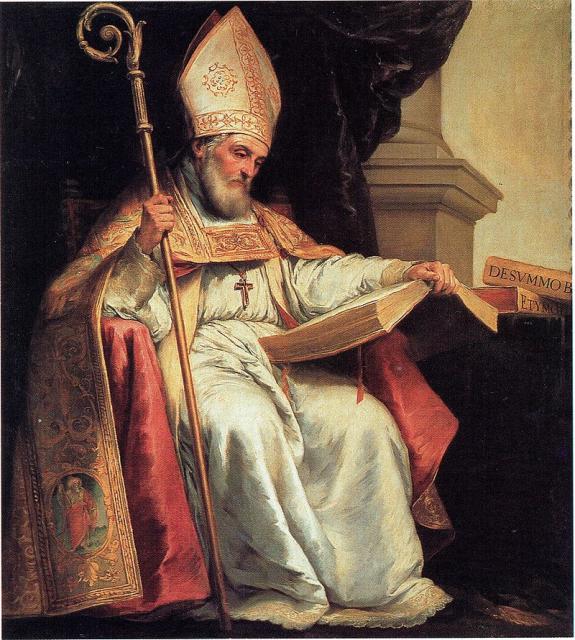
Isidore Seville
 Spain
Spain- Childhood and Early Life
- Education and Career
- Fourth Council of Toledo
- Archbishop of Seville
- Magnum Opus: Etymologies
- Other Works
- Patron Saint of the Internet
- Legacy
Childhood and Early Life
Isidore was born around 560 AD in Cartagena, Spain, to devout Christian parents, Severianus and Theodora. His older brothers, Leander and Fulgentius, and his sister, Florentina, were also later canonized as saints. Isidore lost his parents at a young age and was raised by his brother Leander, who was the Bishop of Seville.
Education and Career
Isidore studied under his brother's guidance and became a scholar in his own right. He entered the ecclesiastical service and served as a spiritual advisor to the Visigothic king, Reccared. Isidore played a pivotal role in converting Reccared from the Arian heresy to Nicene Christianity.
Fourth Council of Toledo
In 589 AD, Isidore presided over the Fourth Council of Toledo, which strengthened the unity between the state and the church and promoted religious tolerance towards Jews. This council is credited with initiating the process of bringing Spain under a single Catholic rule.
Archbishop of Seville
Isidore was appointed Archbishop of Seville in 600/601 AD, becoming the last Latin father of the Church. He is known for his prolific writings and his role as the founder of medieval encyclopedism.
Magnum Opus: Etymologies
Isidore's most celebrated work is the "Etymologies," a 20-volume encyclopedia that attempts to gather the sum of late antique knowledge and organize it according to Christian principles. It covers a wide range of subjects, including grammar, rhetoric, mathematics, medicine, history, law, cosmology, theology, agriculture, and zoology. The "Etymologies" was extraordinarily influential during the Middle Ages, with over a thousand manuscript copies surviving to this day.
Other Works
In addition to the "Etymologies," Isidore authored numerous other works on science, grammar, theology, and history. His "Book of Canons" is a valuable compilation of decrees from both Eastern and Western church councils. He also wrote two chronicles and a history of the Visigothic, Vandal, and Suevi peoples.
Patron Saint of the Internet
Isidore is often referred to as the patron saint of the internet due to his pioneering work in gathering and organizing information. In 1998, Pope John Paul II unofficially designated April 4th as Internet Day in his honor.
Legacy
Isidore of Seville was a prolific writer and influential thinker who bridged the gap between classical antiquity and the Middle Ages. His "Etymologies" became a staple in medieval education, shaping the knowledge base of countless scholars. He is recognized as one of the most important encyclopedists in history and continues to be celebrated for his contributions to Christian thought and the advancement of knowledge.


