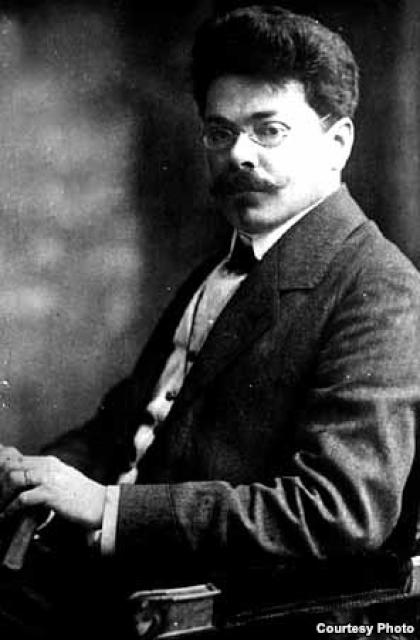
Iuliy Ayhenvald
 Russia
- Early Life and Education
- Career in Moscow
- Critical Writing and Literary Characteristics
- Philosophical and Aesthetic Views
- Literary Interpretations
- Later Works and Legacy
Early Life and Education
Yuliy Isaevich Aikhenvald was born in 1872 to a prominent rabbi in Odessa, Russia. In 1892, he graduated with honors from the history and philology department of Novorossiysk University, where he received a gold medal for his dissertation on the empiricism of Locke and the rationalism of Leibniz.
Career in Moscow
After moving to Moscow, Aikhenvald became secretary of the Philosophical Society and the editorial board of "Questions of Philosophy and Psychology." He lectured on Russian literature at various institutions, including Moscow Women's Pedagogical Courses, Shanyavsky University, and the Higher Women's Courses.
Critical Writing and Literary Characteristics
From 1895 onwards, Aikhenvald published numerous articles and reviews in various journals and encyclopedias. His collected literary characteristics were published as "Silhouettes of Russian Writers" in three volumes (1906-1910). The first volume established his reputation as a brilliant stylist with an imaginative and evocative prose style.
Philosophical and Aesthetic Views
Aikhenvald's critical approach was heavily influenced by German aesthetics, particularly the work of Ernst Meiman. He argued that art was self-sufficient and that artists should not be judged based on their social or ethical beliefs. This stance made him a contentious figure among critics who believed art should serve social or didactic purposes.
Literary Interpretations
Aikhenvald's interpretations of Russian literature were often idiosyncratic and subjektiv. He ignored historical context and focused on his personal impressions of authors' works. While his insights on Pushkin, Baratynsky, and Chekhov were widely admired, his negative assessments of Ostrovsky, Turgenev, and Dostoevsky drew criticism.
Later Works and Legacy
In his later work, Aikhenvald became increasingly political and polemical. His 1910 pamphlet on the poet Valery Bryusov was particularly harsh and dismissive. Despite his critical tendencies, Aikhenvald remained an influential figure in Russian literary criticism. His writings continue to be studied and debated today for their unique perspective and evocative language.


