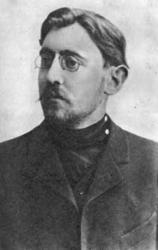
Ivan Blioh
 Poland
- Early Life and Education
- Railroad Tycoon and Banking
- Anticipating the Future of Warfare
- Peace Advocacy and the Hague Conference
- Jewish Advocate and Zionist Supporter
- Legacy and Influence
Early Life and Education
Ivan Gotlieb Bloch was born on July 24, 1836, in Radom, Poland, to a Polish Jewish family. He studied at the University of Berlin, worked at a bank in Warsaw, and later moved to St. Petersburg, then the capital of the Russian Empire.
Railroad Tycoon and Banking
In St. Petersburg, Bloch became involved in financing the construction of new railroads. He also founded several banking, credit, and insurance companies. In 1877, he was appointed to the scientific committee of the Russian Ministry of Finance.
Anticipating the Future of Warfare
Bloch's interest in warfare was sparked by Prussia's decisive victory over France in 1870. His seminal work, "La Guerre Future" (1898), predicted that technological advances such as smokeless powder, rapid-fire rifles, and machine guns would lead to extended front lines and favor defensive strategies. He also foresaw the economic and social devastation that modern warfare would bring.
Peace Advocacy and the Hague Conference
Bloch advocated for peace and disarmament. In 1899, he attended the First Hague Peace Conference, where he distributed copies of his work to delegates from 26 countries. However, his ideas were largely ignored. Nonetheless, he was nominated for the Nobel Peace Prize along with F. F. Martens and Nicholas II.
Jewish Advocate and Zionist Supporter
As a convert to Calvinism, Bloch avoided the legal restrictions imposed on Jews in the Russian Empire. Nonetheless, he became increasingly concerned with the plight of Jews. In response to anti-Semitic pogroms, he appealed to the government to end discrimination and conducted extensive research on the social and economic conditions of Jews in Russia.
Legacy and Influence
Ivan Gotlieb Bloch died on December 25, 1901, in Warsaw, Poland. Though his warnings about the horrors of modern warfare went unheeded, his work foreshadowed the devastation of World War I. Bloch's influence on the development of military strategy and peace advocacy remains significant.