Ivan Bunin
- Childhood and Early Writing
- A Distinctive Literary Voice
- Revolution and Exile
- The Nobel Prize
- Later Years and Legacy
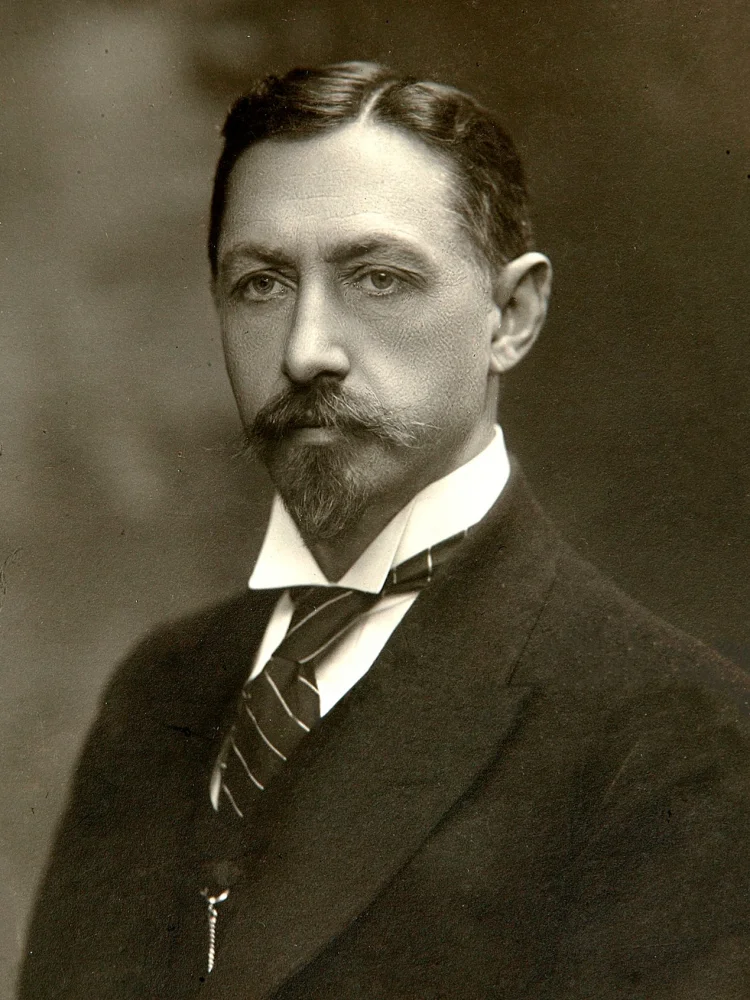
Ivan Bunin brought the Russian countryside to life with a precision that made even quiet scenes feel charged with memory, beauty, and loss. A poet, translator, and master of the short story, he built his reputation before the Russian Revolution and then spent the rest of his life in exile. The 1933 Nobel Prize in Literature made him the first Russian-language writer to receive the award, but it also sharpened the divide between his international acclaim and the country he had left behind.
Childhood and Early Writing
Bunin was born on October 22, 1870, in Voronezh, into an old noble family whose finances were already in decline. He spent much of his childhood on family estates in the central Russian countryside. The landscape, its fields and villages, and the speech and stories of rural people became enduring material for his writing. He began composing poems and stories as a child and later described himself as deeply drawn to painting, an interest reflected in the visual detail of his prose.
His formal education was interrupted when he left school before completing the course. His older brother Yuli, a journalist and writer, tutored him and encouraged his literary ambitions. In 1887, Bunin saw his first poem published. He went on to work for the newspaper Orlovsky Vestnik, where he wrote poetry, prose, criticism, and editorial material. The work gave him a foothold in literary life and introduced him to Varvara Pashchenko, with whom he had an intense but difficult relationship.
A Distinctive Literary Voice
Bunin wrote both poetry and prose, and also translated English-language poetry. His 1901 collection Falling Leaves and his Russian translation of Henry Wadsworth Longfellow’s The Song of Hiawatha won him a Pushkin Prize. In 1909, the Russian Academy of Sciences elected him an honorary academician.
His breakthrough as a prose writer came with The Village, published in 1910. The book rejected sentimental pictures of rural life, presenting village society with starkness and complexity. It provoked heated discussion among critics and readers. Dry Valley followed in 1912, while stories such as “The Gentleman from San Francisco,” “Light Breathing,” and “The Grammar of Love” showed his control of compressed form and atmosphere. Bunin remained independent of the dominant literary schools of his time, and his conservative style stood apart from the symbolism and experimentation then in vogue.
Revolution and Exile
Bunin opposed the Bolshevik Revolution. After the upheavals of 1917, he left Moscow for southern Russia, where he witnessed the violence and instability of the Civil War. His diary, later published as Cursed Days, was a fierce condemnation of revolution and Bolshevik rule. In early 1920, he and his wife, Vera Muromtseva, left Russia and eventually settled in France.
Exile brought both recognition and hardship. Bunin became a prominent voice among Russian émigré writers, continuing to write about the country he had lost while living between Paris and the south of France. His marriage to Muromtseva, whom he had met in 1906, was a vital source of companionship throughout his years abroad. He did not return to the Soviet Union, despite later considering the possibility.
The Nobel Prize
In 1933, Bunin received the Nobel Prize in Literature for the artistry with which he continued the classical Russian prose tradition. He was the first writer working in Russian to win the prize. The recognition was widely celebrated among Russian émigrés, for whom his award felt like an international acknowledgment of a culture dispersed by revolution.
The prize was associated especially with The Life of Arseniev, his autobiographical novel about childhood, memory, and the formation of an artist. It was the largest and most personal project of his exile years. The Nobel brought fame, but it did not remove the material strain of life abroad. Bunin gave away much of the award money to people seeking help, and he continued to face financial difficulties.
Later Years and Legacy
Bunin remained in France during the Second World War. His later collection Dark Avenues, completed in 1944, contains some of his most celebrated stories, including works shaped by longing, erotic intensity, and the passage of time. He continued writing despite poor health and the precarious circumstances of exile.
He died in Paris on November 8, 1953, and was buried at the Russian cemetery of Sainte-Geneviève-des-Bois. For decades, Soviet editions of his work were restricted or censored, particularly writings such as Cursed Days that directly attacked Bolshevik rule. Later publication of a fuller body of his work helped restore his place in Russian literary history.
Bunin’s prose joined a classical command of language with an unsparing eye for human weakness and beauty. His stories made the ordinary landscape memorable, while his novels and diaries preserved the experience of a country transformed by revolution. The Nobel Prize honored the writer he had become in exile; his lasting achievement lies in the clarity and emotional force of the Russian world he continued to write into being.