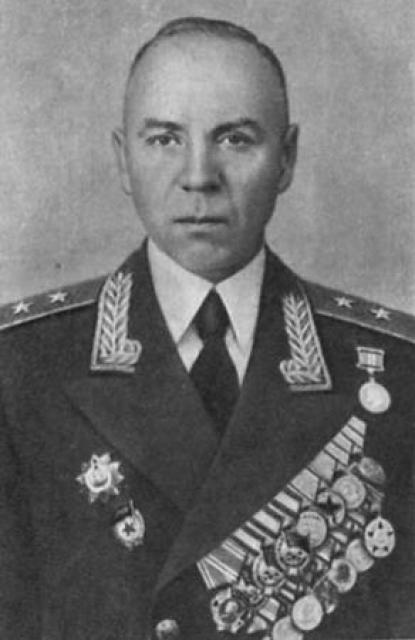
Ivan Laskin
- Early Life and Education
- Youthful Experiences
- Military Career
- Post-Civil War Service
- High-Level Assignments
- World War II and Crimean Defense
- Stalingrad Defense and Negotiations
- Surrender of German Sixth Army
- Legacy and Recognition
Early Life and Education
Ivan Andreyevich Laskin was born into a peasant family on November 1, 1901, in the village of Vasilyevka, Ufa Governorate, Russia. After losing his mother in infancy, Laskin's family relocated to the district town of Belebey in 1912. He briefly attended the parish and city primary schools, but financial constraints forced him to abandon his studies.
Youthful Experiences
Young Laskin worked as a shop assistant, a bricklayer's helper, and a clerk in the city administration. These experiences provided him with valuable life lessons before the outbreak of the Russian Revolution.
Military Career
In 1919, at the age of 18, Laskin joined a military unit based in Belebey. He then enrolled as a cadet in the 3rd Kyiv Cadet Brigade in 1920 and fought in the Crimean campaign, advancing from Yekaterinoslav to Perekop.
Post-Civil War Service
After the Civil War, Laskin completed military studies at the 5th Kyiv Military School and commanded various rifle units in the Caucasus (Manglisi). He subsequently attended the Frunze Military Academy and served as chief of staff of the 132nd Regiment of the 44th Division in Ukraine, where he was promoted in both rank and position.
High-Level Assignments
Laskin avoided the purges that targeted other prominent military leaders of the time. From 1937 to 1939, he served as a special assistant to the commander of the Kyiv Military District, I.F. Fedko, and then to the First Deputy Commissar of Defense of the USSR.
World War II and Crimean Defense
From 1939 to 1941, Laskin commanded the 15th Sivash Motorized Division. At the outbreak of war, he found himself surrounded and captured, but managed to escape. By October 1941, he became chief of staff and later commander of the 172nd Rifle Division, which formed part of the legendary 51st Army and played a crucial role in the defense of Crimea.
Stalingrad Defense and Negotiations
After evacuating from Crimea, Laskin served as deputy chief of staff of the Southeastern Front. From August to September 1942, he commanded the 62nd Army, and from September 7, 1942, to April 17, 1943, he served as chief of staff of the 64th Army, which participated in the defense of Stalingrad. Laskin's leadership earned him several commendations, including promotion to major general in October 1942.
Surrender of German Sixth Army
In January 1943, the Stalingrad Front, including the 64th Army, encircled German forces. Laskin led a group of officers to meet Field Marshal Friedrich Paulus and negotiate German surrender. He later described this encounter in his book, "On the Path to Victory."
Legacy and Recognition
General-Lieutenant Ivan Andreyevich Laskin made significant contributions to the defense of Crimea and Stalingrad. His courage and leadership played a vital role in the Soviet victory, and his meeting with Field Marshal Paulus remains a defining moment in military history.





