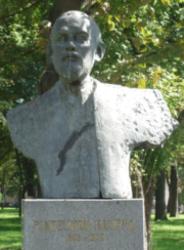
Ivan Taubert
 Russia
- Ivan Andreyevich Taubert: A Statesman and Librarian
- Education and Early Career
- Academy Librarian and Censor
- Conflict with Lomonosov and Control of the Academy
- Decline and Later Years
Ivan Andreyevich Taubert: A Statesman and Librarian
Ivan Andreyevich Taubert (August 31, 1710 - May 9, 1771) was a man of significant influence in the Russian Academy of Sciences (RAS) during the 18th century.
Education and Early Career
Born into a German family, Taubert commenced his studies at the RAS Gymnasium in 1726 and was promoted to the rank of student in 1734. He joined the Russian Assembly as a translator in 1735 and became an adjunct in the historical department of the academy in 1736.
Academy Librarian and Censor
Taubert was appointed sub-librarian of the academy library in 1741, responsible for cataloging and reviewing books. Contemporaries noted that his tenure as librarian created conflict with many professors and students. Despite protests over his supervision of professors, Taubert's career remained largely undisturbed. He also participated in the publication of the "Saint Petersburg Vedomosti" newspaper until 1748.
In 1756, Taubert was appointed censor of the "Ezhemesyachnye sochineniya" journal, and in 1757, he assisted in the administration of the academy's chancellery. He was also a constant adversary of Mikhail Lomonosov, opposing his plans to expand the number of gymnasium and university students.
Conflict with Lomonosov and Control of the Academy
Taubert's power within the academy grew in 1758 when he was given oversight of the printing house, type foundry, mechanical laboratory, and bookstore. In 1759, the printing house was placed entirely under his control. In 1761, he obtained permission to publish a collection of Russian chronicles titled "Biblioteka rossiyskogo naroda."
Taubert's involvement in the 1762 coup d'état further cemented his position. He was instrumental in printing the manifesto that ushered in the reign of Catherine the Great. Subsequently, he was bestowed the title of state councilor and gained control of the academy's chancellery.
Decline and Later Years
Taubert's influence waned over time, despite Lomonosov's death in 1765. In 1766, with the appointment of Grigory Orlov as director of the academy, Taubert lost his power. The chancellery was abolished, and a commission was established to manage the academy's affairs. Taubert was appointed a member of this commission but had no real authority.
In his later years, Taubert focused on writing several books before his death in 1771.