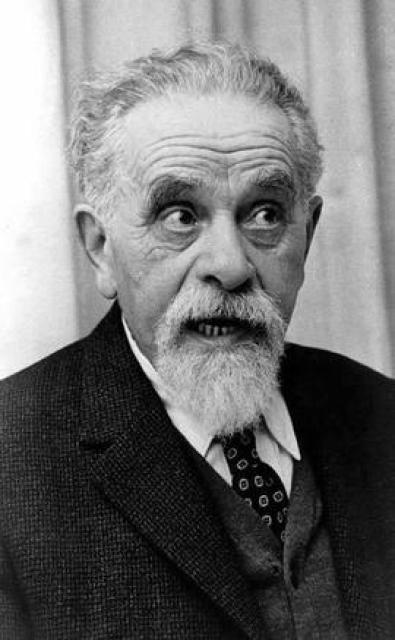
Izaak Gruenbaum
 Israel
- Biography of Itzhak Greenbaum
- Journalism and Zionist Ideals
- Political Involvement and Advocacy
- Controversies and Later Years
- Itzhak Greenbaum passed away in 1970.
Biography of Itzhak Greenbaum
Itzhak Greenbaum, born on November 27, 1879, in Warsaw, was a Polish Zionist leader, writer, and the first Minister of Internal Affairs of Israel. His family moved to Płock in 1881, where Greenbaum received his primary education in a cheder and gymnasium. After graduating from the gymnasium, he returned to Warsaw and enrolled in the law faculty of Warsaw University.
Journalism and Zionist Ideals
Greenbaum began his career in journalism while still a student, writing extensively in Hebrew, Russian, Yiddish, and Polish. His articles advocated the ideas of the "Service of Modernity" Zionist movement, inspired by Martin Buber. These ideas emphasized the return to the Holy Land as the solution to the Jewish national problem while also prioritizing the development of the Jewish diaspora.
Political Involvement and Advocacy
Greenbaum was one of the co-authors, along with Ze'ev Jabotinsky, of the "Helsingfors Plan," a Zionist movement program advocating for equal rights for all national minorities. He actively participated in all Zionist congresses, consistently fighting for the rights of secular Jews and the status of Yiddish language in Zionist institutions.
In 1919, Greenbaum became a deputy in the Polish Sejm. As part of his parliamentary work, he joined the Constitutional Committee and contributed to the development of the Polish Republic's constitution. In 1922, he founded the "Minority Bloc" in the Sejm, uniting Russians, Ukrainians, Germans, Jews, and other national minorities. The bloc aimed to oppose the planned division of Poland into electoral districts, which would have neutralized the electoral potential of national minorities. Under Greenbaum's leadership, Jewish parties achieved unprecedented success, winning 35 parliamentary seats.
Controversies and Later Years
In 1927, Greenbaum decided to boycott representatives of the religious Orthodox party "Agudat Israel," resulting in none of their candidates being elected to the Sejm. In response, in 1930, Agudat Israel nominated Rabbi Aharon Levin, a popular local figure among the Jewish community, as their candidate in the same electoral district as Greenbaum. Greenbaum lost the election, giving up his seat to Levin.
Greenbaum was also one of the founders of the "Tarbut" (Culture) association, dedicated to the development of secular Jewish culture and education among the Jewish diaspora. He served as the head of the Israeli Jewish community's representation in Poland and the head of the Israel Development Fund in the country. In 1925, Greenbaum visited Palestine for the first time.
In 1933, he was elected to the Zionist leadership during the 18th Zionist Congress. Later that year, he immigrated from Poland to Palestine. From then until 1948, Greenbaum held various leadership positions in the Jewish Agency and the Zionist Federation. He also led the "Bialik Institute," dedicated to preserving and disseminating Jewish cultural heritage.
In April 1948, on the eve of the establishment of the State of Israel, Greenbaum was elected to the Provisional State Council and became the first Minister of Internal Affairs of Israel. During his tenure, he organized the preparation for the first elections to the Knesset, where he ran at the head of his own list, the "Itzhak Greenbaum List." However, the list did not surpass the electoral threshold.
After his electoral defeat, Itzhak Greenbaum moved to Kibbutz Gan Shmuel, where his son was a member. There, he focused on editorial and publishing activities, preparing books such as the "Encyclopedia of the Diaspora," "The Zionist Movement and Its Development," and many others.


