Jacob
- The younger twin and the stolen blessing
- Israel and the struggle for home
- A patriarch across traditions
Jacob’s story in Genesis is one of family rivalry, hard-won change, and reconciliation. A younger twin who once grasped his brother’s heel, he becomes the father of the twelve sons associated with the tribes of Israel and is given the name Israel himself. In Judaism, Christianity, and Islam, he is remembered as a patriarch and a man of faith whose life moved through conflict, loss, and the hope of reunion.
The younger twin and the stolen blessing
The biblical account introduces Jacob as the son of Isaac and Rebekah and the twin brother of Esau. Their rivalry begins before birth, and Rebekah receives a prophecy that the older will serve the younger. Esau grows into a hunter, while Jacob is portrayed as more at home among the tents. First, Jacob obtains Esau’s birthright in exchange for a meal. Later, with Rebekah’s help, he disguises himself as his brother and receives the blessing their elderly father intends for Esau.
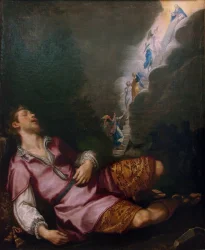
The deception brings Jacob the blessing but also drives him from home. On the journey to his mother’s family, he dreams at Bethel of a stairway reaching to heaven and receives a promise that his descendants will inherit the land. He arrives at the home of his uncle Laban and falls in love with Laban’s younger daughter, Rachel. After seven years of work, Laban deceives him by giving him Leah instead. Jacob eventually marries Rachel as well and works additional years for the family and flocks.
Israel and the struggle for home
Jacob becomes the father of twelve sons and a daughter, Dinah. The sons, born to Leah and Rachel and to their servants Bilhah and Zilpah, become the traditional ancestors of Israel’s tribes. Jacob’s preference for Rachel’s son Joseph fuels painful jealousy among the brothers. They sell Joseph into slavery and convince their father that he has died, leaving Jacob to grieve for years.
On the return journey to Canaan, Jacob spends a night wrestling with a mysterious figure. He receives a new name, Israel, associated in Genesis with striving with God and people. The encounter precedes a long-feared meeting with Esau. Instead of revenge, the brothers embrace and make peace. The scene offers a striking counterpoint to their earlier rivalry: the man who once secured his future through deception now approaches his brother with humility and gifts.
Years later, news that Joseph is alive draws Jacob and his family to Egypt during famine. Before his death, Jacob blesses his sons and asks to be buried with his ancestors in Canaan. His life, as told in Genesis, links the ancestral stories of Abraham and Isaac with the emergence of the Israelite people.
A patriarch across traditions
Jewish tradition counts Jacob as the third patriarch, after Abraham and Isaac, and sees the name Israel as the source of the people’s collective identity. The New Testament recalls him alongside the earlier patriarchs. In Islam, Yaʿqūb is a prophet, the son of Isaac and father of Joseph; the Qur’an presents him as a steadfast believer and the bearer of his family’s faith.
Jacob’s biography belongs to sacred tradition rather than a modern, independently documented historical record. Across the traditions that honor him, his legacy is shaped by family ties, perseverance, and transformation: the heel-grasping younger brother becomes Israel, the ancestor whose name is carried by a people.