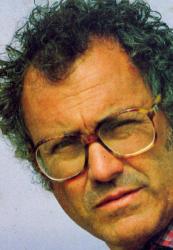
Jacques Dupin
 France
- Early Life and Influences
- Literary and Artistic Connections
- Surrealist Engagements:
- Artistic Collaborations:
- Literary Career
- International Recognition:
- Later Collaborations:
- Recognition and Legacy
- Immortalized in Portraiture:
Early Life and Influences
Childhood and Loss:Jacques Dupin was born in 1927 and lost his father at the tender age of four. He spent his childhood in the French countryside.
Literary and Artistic Connections
Arrival in Paris:In 1944, Dupin moved to Paris, where he would spend the rest of his life. In 1947, he met the renowned poet René Char, who became a significant mentor and remained a close friend until 1975.
Surrealist Engagements:
In the late 1940s, Dupin encountered notable figures from the surrealist movement, including Francis Ponge, Georges Braque, Albert Camus, and Georges Bataille. In 1950, he became secretary of the journal and publishing house "Cahiers d'Art" ("Art Notebooks").
Artistic Collaborations:
Dupin became an integral part of the Parisian art scene, befriending and collaborating with artists such as Constantin Brâncuși, Véra Lam, Alexander Calder, Nicolas de Staël, Pablo Picasso, Joan Miró, André Masson, Alberto Giacometti, and Robert Rauschenberg. His friendships with these artists greatly influenced his poetry and artistic criticism.
Literary Career
Journalism and Publishing:In 1955, Dupin began collaborating with the Galerie Aimé Maeght, overseeing their publishing initiatives, including the journal "Derrière le miroir" ("Through the Looking Glass"). From 1966 to 1972, he co-founded and published the journal "Éphémère."
International Recognition:
In the 1960s, Dupin's reputation grew internationally. In 1969, he met Paul Auster, who became a close collaborator and translated his poems into English. They performed readings together in New York and London.
Later Collaborations:
In the 1970s and 1980s, Dupin continued to collaborate with renowned artists, including Henri Michaux and Antoni Tàpies. He also published monographs on Miró, Giacometti, and Tàpies.
Recognition and Legacy
National Poetic Prize:In 1988, Dupin was awarded the prestigious National Poetic Prize. His work has been translated into multiple languages and set to music by French composers.
Immortalized in Portraiture:
In 1990, Francis Bacon painted a portrait of Dupin, further cementing his status as a significant figure in both literature and art.