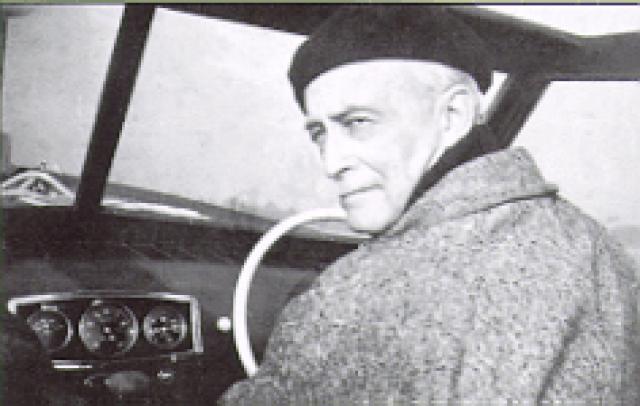
Jacques Francois Ibert
 France
Biography of Jacques Francois Ibert
Jacques Francois Ibert (1890-1962) was a French composer known for his witty and elegant compositions. He was born on August 15, 1890, in Paris. Ibert studied at the Paris Conservatory under the guidance of Gabriel Fauré, André Gedalge, and Eugène Pessard. During his time at the conservatory, he received awards in harmony, counterpoint, and fugue, and in 1919, he was awarded the Rome Prize for his cantata "Le Poète et la Fée" (The Poet and the Fairy).
Despite being a close friend of Darius Milhaud during his conservatory years, Ibert's compositions were not heavily influenced by Milhaud's work. Instead, he can be compared to another French composer, Albert Roussel.
In 1920-1923, Ibert lived in Rome, and one of his early Roman compositions was "Ballade de la Geôle de Reading" (Ballad of Reading Gaol, 1920) based on Oscar Wilde's poem. In 1947, the ballad was staged as a ballet at the Paris Opera-Comique. It became evident that Ibert brought a distinct and refined touch to French music, characterized by his penchant for wit and elegance, free from vulgarity. This can be seen in his theatrical works, particularly the comic operas "Angélique" (1927) and "Le Roi d'Ivetot" (1930).
One of the highlights of Ibert's Roman period was his symphonic triptych "Escales" (Ports of Call), which includes three picturesque movements: "Rome-Palermo," "Tunis-Nefta," and "Valencia." His Concerto for Cello and Wind Instruments (1925) can be considered a parody of the classical concerto genre, while his Concertino da camera for flute and small orchestra (1934) has become a classic of 20th-century music. His String Quartet in C major (1943) and Trio for Violin, Cello, and Harp (1944) showcase his polished composition style.
Among his later works, notable compositions include the ballets "Les Amours de Jupiter" (1946) and "Le Chevalier errant" (The Wandering Knight, 1950), as well as the "Symphonie concertante" for oboe and string orchestra (1949) and the "Louisville Concerto" (1954).
Ibert made history as the first musician to serve as the director of the French Academy in Rome, a position he held from 1937 to 1961. Afterward, he became the director of the National Association of Opera Theatres, overseeing the Grand Opera and Opera-Comique. He passed away in Paris on February 5, 1962.


