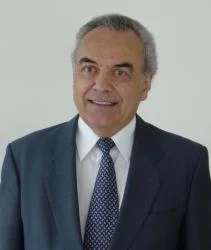
James Watson
 United States
- From Chicago to Cambridge
- The double helix and the people behind it
- Research leadership and the Human Genome Project
- Controversy and later years
James Watson helped bring molecular biology into the public spotlight. His collaboration with Francis Crick produced the first widely accepted model of DNA’s double-helix structure in 1953, a discovery that transformed biology and earned him a Nobel Prize. The story also depended on crucial work by Rosalind Franklin, Maurice Wilkins, and other researchers. Watson later became a leading science administrator and author, but his public legacy was deeply damaged by repeated racist claims about intelligence and genetics.
From Chicago to Cambridge
James Dewey Watson was born in Chicago, Illinois, on April 6, 1928. A gifted student, he entered the University of Chicago at age 15 and earned a degree in zoology. He completed a doctorate at Indiana University in 1950, studying viruses that infect bacteria in the laboratory of geneticist Salvador Luria. The work placed him in the emerging field of molecular biology, where scientists were trying to understand how genes functioned at the level of molecules.
After research appointments in Europe, Watson joined the Cavendish Laboratory at the University of Cambridge in 1951. There he met Francis Crick, a physicist turned biologist who shared his interest in DNA. They began building models of the molecule, drawing on chemical evidence and research emerging from other laboratories.
The double helix and the people behind it
In 1953 Watson and Crick proposed a model in which two complementary strands of DNA coil around one another. Their structure explained how genetic information could be stored and copied. The work drew on critical X-ray diffraction research at King’s College London, particularly Rosalind Franklin’s measurements and images, as well as findings from Maurice Wilkins and colleagues. Franklin and her student Raymond Gosling, and Wilkins with collaborators, published papers alongside Watson and Crick’s model in the same issue of Nature.
The use and sharing of Franklin’s unpublished data became a lasting point of debate. Watson and Crick had access to key results from King’s without Franklin’s direct involvement in the Cambridge collaboration, and she was not fully aware of how some of the information had reached them. Later accounts and historical scholarship have reconsidered her contribution, which early popular stories often minimized. Franklin died of cancer in 1958, before the Nobel Prize was awarded; in 1962, Watson, Crick, and Wilkins shared the Nobel Prize in Physiology or Medicine.
Watson wrote the bestselling memoir The Double Helix in 1968, presenting the discovery as an intense contest of personalities and ideas. Its irreverent style made science vivid for general readers, but its treatment of colleagues, especially Franklin, also drew criticism and helped shape public perceptions of the discovery for decades.
Research leadership and the Human Genome Project
Watson taught at Harvard and became director of Cold Spring Harbor Laboratory in 1968. During his leadership, the Long Island institution grew into a major center for molecular biology and genetics, with influential research and education programs. His textbook Molecular Biology of the Gene, first published in 1965, helped define how generations of students learned the field.
In 1988 he became the first director of the National Center for Human Genome Research at the U.S. National Institutes of Health, helping launch the Human Genome Project’s effort to map and sequence human DNA. He resigned in 1992 after a disagreement with NIH leadership over gene patenting and the handling of genomic discoveries, then returned to his work at Cold Spring Harbor. He remained a powerful and often outspoken figure in the scientific community.
Controversy and later years
Watson’s later public comments about race, intelligence, and genetics brought sustained condemnation from scientists and civil-rights advocates. In 2007, after he made claims linking racial differences in intelligence to genetic factors, he apologized for the hurt caused; Cold Spring Harbor Laboratory removed him from administrative duties and ended his chancellorship. In 2019, after he repeated similar claims in a documentary, the laboratory revoked his remaining honorary titles. The claims were not supported by sound scientific evidence, and his remarks became a defining part of his late-life reputation.
Watson died on November 6, 2025, at age 97. His career left a complicated record: a landmark scientific model, influential teaching and institution-building, and a celebrated narrative of discovery that has been revised to recognize collaborators whose contributions were once obscured. His history shows how scientific breakthroughs can depend on shared work, while credit, power, and public memory remain unevenly distributed.