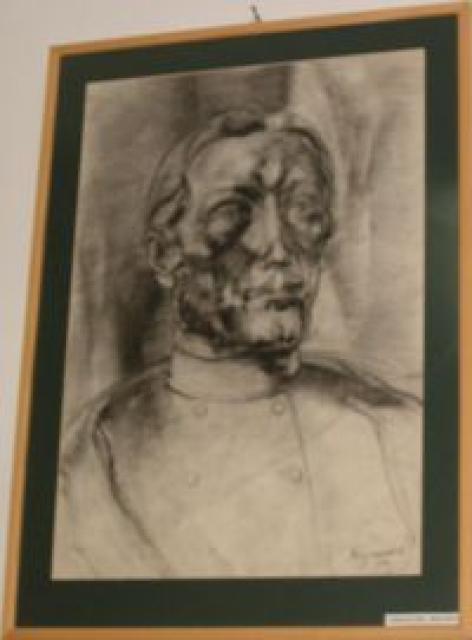
Janosh Boyai
 Hungary
Biography of János Bolyai
János Bolyai, a Hungarian mathematician, was one of the pioneers of non-Euclidean geometry, now known as Lobachevskian geometry. He was born in the Transylvanian city of Kolozsvár, which is now Cluj-Napoca, Romania, but was then part of Austria-Hungary. His father, Farkas Bolyai, a renowned mathematician, taught him the basics of mathematics from an early age. In 1822, János completed his studies at the Military Engineering College in Vienna, completing the seven-year course in just four years. It was during his time at the college that he became fascinated with the exploration of the fifth postulate of Euclid, much to his father's concern. Farkas advised his son to abandon this "repulsive perversion," warning him that it could consume his time, health, sanity, and all the joys of life. He even suggested that this black abyss could swallow up a thousand titans like Newton...
However, János did not heed his father's advice. Soon, he came to the conclusion that the fifth postulate was unprovable and independent of the others. This meant that by replacing it with an alternative, a new geometry could be constructed, different from Euclidean geometry. In a letter to his father, he joked, "I have created a strange new world out of nothing!"
Around 1820-1823, Bolyai completed a treatise describing his new geometry. In 1823, he joined the army as a junior lieutenant in the military engineering corps and served for 11 years. He was regarded as an excellent officer and a remarkable dancer. He was fluent in nine languages, including Chinese and Tibetan, and never drank alcohol or smoked.
In 1832, his father published his own work, including his son's work as an appendix. János Bolyai's full work was titled "Appendix, Containing an Absolutely True Science of Space, Not Depending on the Truth or Falsity of the Eleventh Axiom of Euclid (which a priori can never be decided)". Unfortunately, the "Appendix," like Lobachevsky's works, remained misunderstood and unnoticed.
In 1831, Farkas Bolyai sent the "Appendix" to his longtime friend and the then "king of mathematicians," Gauss. After reading the treatise, Gauss wrote to one of his friends, "This young geometer Bolyai is a genius of the highest order." It was later discovered that Gauss had secretly developed non-Euclidean geometry himself since the early 1820s but never published anything on the subject. Gauss replied to Farkas, "To evaluate this would be the same as evaluating myself because everything written there coincides with my own thoughts on this subject for the past 30-35 years." The news that he had been surpassed devastated the young Bolyai, who had just been promoted to captain. His health deteriorated, his character changed, and he soon retired in 1833 without earning a pension, living on his father's funds.
In 1834, János entered a civil marriage with Rozália Kibédi Orbán, with whom he had two children.
Bolyai attempted to continue his mathematical work and started several interesting manuscripts but soon abandoned them. In 1848, he came across Lobachevsky's work, which had been published three years before his own. Bolyai was furious. He suspected that his best ideas had been stolen and believed that Lobachevsky did not actually exist, accusing Gauss of being behind it all. However, he also admired the skill and wit of Lobachevsky's proofs.
The last years of Bolyai's life were marred by severe mental distress.
In 1852, he separated from Rozália. He began several new research projects but never completed any of them. After his death, more than 20,000 unfinished mathematical manuscripts were discovered. However, the "Appendix" remained his only work published during his lifetime.


