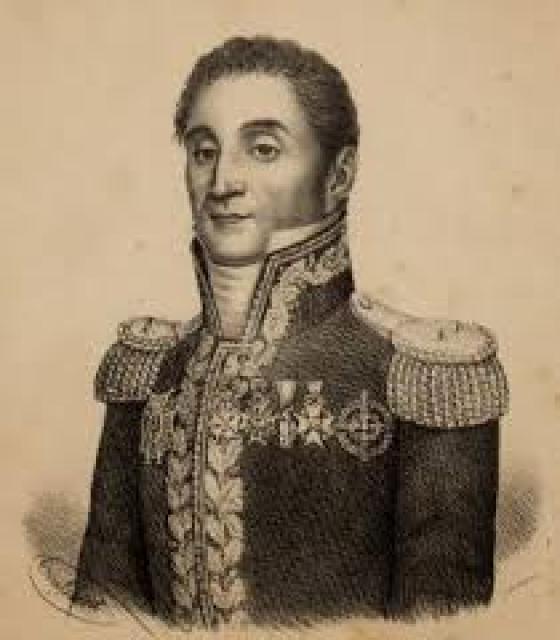
Jean-Baptiste Bruny
 France
- Birth and Early Military Career
- Revolution and the Rise to Prominence
- Napoleonic Wars and Captivity
- Return to France and the War of 1809
- Invasion of Russia and Siege of Berlin
- Military Trials and Later Years
- Post-Napoleonic Career and Retirement
Birth and Early Military Career
Guillaume Marie Anne Brune was born on November 19, 1769, in Lyon, France. He enlisted in the French military as a soldier on June 6, 1785. By the outbreak of the French Revolution, he had risen to the rank of sergeant in the Lyon Regiment.
Revolution and the Rise to Prominence
During the revolutionary events of 1790 and 1791 in Aix and Montpellier, Brune distinguished himself and was promoted to colonel. He served in the Rhine Army in 1794 and 1795, fighting against the First Coalition. In 1796, he became chief of staff in Ferrino's division and gained acclaim for his performance at the battle of Oberkamlach, where he recaptured Republican prisoners from the royalists.
Napoleonic Wars and Captivity
After Napoleon Bonaparte became Consul, Brune participated in the Caribbean expedition. During the expedition, he was captured by the British at Santo Domingo and spent several months as a prisoner in Jamaica.
Return to France and the War of 1809
Upon his return to France in late 1804, Brune played a significant role in reforming French regiments. His next campaign was the 1809 war against Austria. As part of the Italian Army, Brune distinguished himself multiple times, earning the title of Baron of the Empire and the Order of the Legion of Honor.
Invasion of Russia and Siege of Berlin
Promoted to brigadier general on August 6, 1811, Brune took part in Marshal Ney's corps during the 1812 invasion of Russia. He fought in numerous battles, including Borodino, where he commanded the 3rd brigade of the 10th infantry division and received the Commander's Cross of the Legion of Honor.
Following the retreat from Moscow and several rearguard actions, Brune found himself in Prussia. He was appointed Governor-General of Stettin but was unable to assume his post due to the Russian Army crossing the Prussian border. Instead, he became Chief of Staff to Marshal Saint-Cyr. During the Allied siege of Berlin, Brune commanded the defense of the Spandau fortress, surrendering after a lengthy siege on honorable terms.
Military Trials and Later Years
Napoleon ordered Brune to be tried by a military tribunal, but the proceedings were never held. Brune was instead assigned to command units in Antwerp. Upon the accession of Louis XVIII, Brune was appointed to Corsica. During the Hundred Days, he remained loyal to the king and defended Ajaccio against insurgents supporting Napoleon.
Post-Napoleonic Career and Retirement
Following the Second Restoration, Brune was appointed commander of the 17th Military District. He was awarded a sword of honor for his defense of Ajaccio. Subsequently, Brune commanded several military districts in mainland France before retiring on August 19, 1830. He passed away on June 11, 1846.


