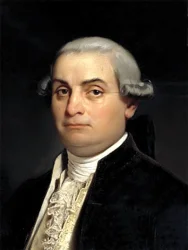
Jean-Baptiste Say
Jean-Baptiste Say was a French economist who brought the ideas of Adam Smith into wider circulation while developing an influential account of production, markets and entrepreneurship. He combined economic theory with the experience of journalism, politics and manufacturing. His best-known idea, later called Say’s law, became one of the most debated principles in classical economics.
From Lyon to public life
Say was born in Lyon on January 5, 1767, into a Protestant family with commercial roots. As a young man he worked in business in England and France, where he encountered the writings of Adam Smith. The French Revolution drew him into journalism and politics. In 1794, he became involved in the journal La Décade philosophique, which discussed politics, literature and economics.
He later joined the Tribunate, one of the legislative bodies created under Napoleon Bonaparte. Say’s liberal economic views increasingly put him at odds with the government. When the first edition of his Traité d’économie politique appeared in 1803, its criticism of excessive state direction displeased Bonaparte. Say was removed from political office and turned to business.
Economist and entrepreneur
Say established a cotton-spinning business in northern France, drawing on the machinery and technical knowledge he had studied. The experience gave him a practical view of production, investment and the role of entrepreneurs in organizing resources and taking commercial risks. In 1814, after Napoleon’s fall, he returned to publishing and teaching.
The Traité d’économie politique, or Treatise on Political Economy, presented economics as a systematic study of how wealth is produced, distributed and consumed. Say emphasized that production creates income, which in turn allows people to purchase other goods and services. This argument was later summarized as “supply creates its own demand,” although that phrase can oversimplify his meaning. His broader point was that general economic crises could not be explained simply by a permanent shortage of money or demand; particular markets could still suffer from imbalances.
Say’s argument became a major point of dispute. Thomas Malthus and, later, John Maynard Keynes challenged versions of the idea, especially in debates over whether economies could experience prolonged general shortfalls in demand. The controversy helped keep Say’s name central to economic thought long after his lifetime.
Teaching and legacy
Say became a leading teacher of political economy in France. He taught at the Conservatoire des Arts et Métiers and, in 1831, took up a newly established chair of political economy at the Collège de France. His lectures and books helped make economics a recognized academic subject in the country.
He died in Paris on November 15, 1832. Say’s legacy rests on more than a single “law”: he shaped French economic liberalism, stressed the productive role of entrepreneurs and gave generations of readers a clear framework for thinking about how economies work.