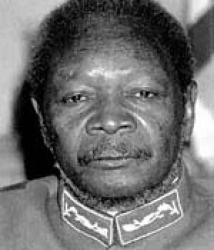
Jean-Bedel Bokassa
 CAR
CARBiography of Jean-Bedel Bokassa
Jean-Bedel Bokassa was a dictator and one of the most eccentric rulers of the 20th century. He was known as a tyrant, sadist, and cannibal. Bokassa was born in 1921 in the Central African Republic (CAR), which was then under French protectorate. At the age of 19, he enlisted in the French colonial troops. He had a modest military career, serving as a second-class soldier during World War II and later in Saigon, Vietnam, where he fought against the Vietnamese. He was promoted to officer and awarded the Legion of Honor.
While Bokassa was away, his cousin David Dacko became the president of the newly independent CAR. Dacko invited Bokassa to return home, and he did so in 1960. Bokassa was appointed as the Chief of the Military Cabinet and quickly rose through the ranks in the country's army, eventually becoming a marshal. However, Bokassa wanted more power and, on January 1, 1966, he overthrew his cousin to become the president of CAR.
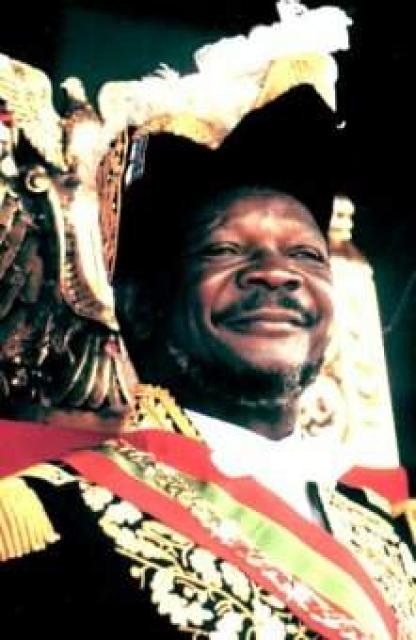
As president, Bokassa also took on the roles of Prime Minister, Minister of National Defense, Minister of Information, and Chairman of the country's only allowed party, the "Movement for Social Evolution of Black Africa." In 1970, he visited the Soviet Union and was personally received by General Secretary Brezhnev. However, being president was not enough for Bokassa, and in 1972, he declared himself the lifelong president. In 1977, he followed in Napoleon's footsteps and declared himself emperor. He even had a coronation ceremony, costing the impoverished country $20 million. The coronation crown, made by a Parisian jeweler, was adorned with precious jewels, including a 58-carat heart-shaped diamond.
Bokassa's extravagant lifestyle included multiple wives - a total of 17. However, only one of his wives, Catherine Sola, participated in the coronation ceremony. The event included lavish decorations, clothing, and food, with 7 tons of flowers, 5200 liveries, 600 formal suits, 25,000 bottles of Burgundy and Champagne, and 10,000 pieces of silverware. The coronation spectacle was orchestrated by the famous French decorator Jean-Pierre Dupont.
Despite being the emperor of one country, Bokassa held citizenship in another. In 1958, he was recognized as a pure-blooded Frenchman in Brazzaville. By the time of his coronation, Bokassa had become not only a killer on the throne but also a cannibal. After his overthrow, parts of human bodies were found in his refrigerator, and his former chef, Philippe Langis, revealed that he was forced to cook dishes using human flesh. Bokassa even ordered the killing of one of his ministers, made a meal out of him, and served it to the other ministers without revealing the secret until the end of the meal.
Described by a journalist who met him in the late 1970s, Bokassa was a small man with a fluid mustache, oily eyes, and a wrinkled face. His appearance in a marshal's uniform did not inspire fear but rather laughter. Bokassa awarded himself numerous titles, orders, and medals, brazenly plundered the treasury with his associates, purchased luxurious homes and castles abroad, and indulged in extravagant parties while the country suffered from poverty. Only the support of France and its President, Valéry Giscard d'Estaing, allowed Bokassa, with his army of 3,000 soldiers ruling over a population of three million, to remain in power for so long.
Eventually, the desperate people rose up against their tyrant. The first uprising occurred in January 1979 when schoolchildren and students protested against the mandatory wearing of uniforms made in Bokassa's textile factory. Peaceful demonstrations turned into a revolt, and the military suppressed it, killing around 150 people. In April of the same year, similar protests erupted in the city, leading to a spontaneous uprising with barricades and attacks on official residences. The imperial guard and military units embarked on a brutal hunt for children and young people between the ages of 6 and 25.
According to French journalists, hundreds of children were imprisoned in the central prison near the diplomatic quarter, where soldiers stomped on them and locked them in cells. Out of rage, Bokassa spent two nights in the prison, giving the children a "good lesson." As a result, about a hundred people died. The bodies were secretly buried in mass graves or thrown into the river.
Bokassa cynically justified his actions, claiming to be the leader of a nation of thieves. He said that he sometimes beat them to discipline them and argued that the number of deaths caused by his regime was insignificant compared to the number of deaths on French roads during Easter. Despite such brutal acts, some people nostalgically remembered Bokassa's reign, as they were at least able to eat something.
As the situation worsened, France could no longer maintain a facade of support for Bokassa and sent a military intervention to CAR. Initially, they tried to persuade him to abdicate voluntarily, but Bokassa angrily rejected President Giscard d'Estaing's envoys, claiming that he could turn to the Russians for help. In September 1979, during Bokassa's visit to Libya, a French parachute division landed in Bangui, the capital of CAR, under the pretext of protecting French citizens. Bokassa was overthrown, and his cousin David Dacko, who had been deposed by Bokassa 13 years earlier, took his place as the new president.
After his overthrow, Bokassa searched for a place to live. He resided in his castle in France near the city of Melun for some time, but eventually had to move to the Republic of Ivory Coast. It was the only country that agreed to grant him asylum. However, a few years later, with the situation calming down, Bokassa returned to France, most likely with the help of his influential French friends whom he had generously supported during his reign. However, he was not allowed to leave his castle. During this time, the former emperor found new friends among the ultra-right National Front party. These nationalists encouraged Bokassa to return to his homeland, believing that he would be welcomed with open arms, just like Napoleon when he escaped from Elba.
On October 23, 1986, Bokassa arrived in Bangui under a false name with his wife Catherine and five children on a regular passenger flight. However, instead of jubilant crowds, soldiers were waiting for the ex-emperor. Bokassa was arrested and put on trial. He had already been sentenced to death in absentia for genocide and cannibalism. The trial confirmed the previous charges, but the sentence was commuted to 20 years of hard labor. Later, the sentence was reduced to 10 years, and in August 1993, Bokassa was released from prison. The decision was made by President André Kolingba, who had served as Bokassa's bodyguard in the early days of his career.
After his release, Bokassa once again demonstrated his acting skills. He appeared on national television wearing a white robe and a large cross on his chest, claiming to be an apostle ready to respond to the people's needs. However, his calls went unanswered, although there were still some who nostalgically remembered Bokassa's reign. Despite his past, Bokassa sought to regain power in the country. However, the authorities rejected his request for amnesty, and he was expelled from the presidential palace. Bokassa continued to live in Bangui, receiving a pension as a French veteran. In the spring of 1996, he applied for amnesty from the new President Ange-Félix Patassé. Amnesty would have allowed him to participate in the 1999 presidential elections.
Unfortunately, Bokassa's plans were cut short by his death. He died of a heart attack on the night of October 28, 1996.