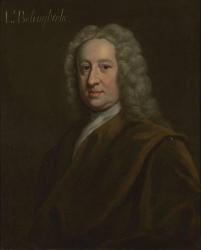
Jean de La Bruyere
 France
- Early Life and Career
- Observations on Society
- "Characters" and Controversy
- Influence of the Ancients
- "Characters" as a Sociopolitical Mirror
- Social Criticism and Enlightenment Influences
- Death and Legacy
Early Life and Career
Jean de La Bruyère was born on August 16, 1645, in Paris, into a family of government officials and the bourgeoisie. He pursued legal studies before being appointed, at the behest of Jacques-Bénigne Bossuet, tutor to the young Duke of Burgundy and later secretary to Prince Condé.
Observations on Society
With a contemplative and reserved nature, La Bruyère immersed himself in observing and analyzing the distinct social types of his time. These observations formed the basis of his magnum opus, "Characters, or Morals of This Century" (1688).
"Characters" and Controversy
In "Characters," La Bruyère deftly portrayed individuals from various societal strata, disguising real-life prototypes with fictional names. However, many of these subjects recognized themselves and resented their satirized depictions. This backlash likely contributed to La Bruyère's failed bid for membership in the French Academy in 1691.
Influence of the Ancients
Despite opposition from the "moderns" in the "Quarrel of the Ancients and Moderns," La Bruyère defended the literary value of classical authors. In 1693, he was elected to the Academy, becoming a staunch advocate for the ideals of classicism.
"Characters" as a Sociopolitical Mirror
Inspired by Theophrastus's "Characters" (4th century BCE), La Bruyère's work aspired to reflect the social mores of his era. The book's original edition included a translation of Theophrastus's work, complemented by La Bruyère's own insights. Over the course of nine editions, "Characters" expanded significantly, evolving from a supplement to Theophrastus to an influential work in its own right.
Social Criticism and Enlightenment Influences
La Bruyère's writings expressed a bitter awareness of class inequality and the disregard shown by the nobility and wealthy bourgeoisie for the plight of the ordinary people. His observations paved the way for the Enlightenment ideology that would challenge social injustices and seek to promote rational thought and human progress.
Death and Legacy
Jean de La Bruyère died on May 11, 1696, in Versailles. His "Characters" remains a significant work of French literature, celebrated for its insightful portrayal of human nature and its contribution to the intellectual landscape of the Enlightenment era.