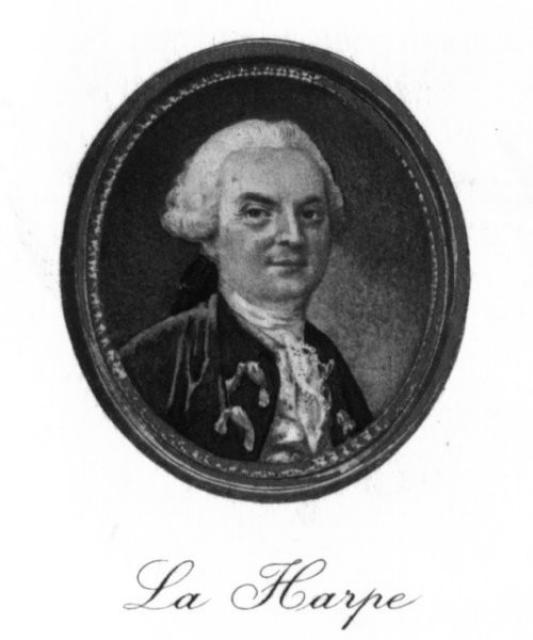
Jean-Francois La Harpe
 France
- Jean-François de La Harpe: A Master of Neoclassicism
- Transitions to Journalism and Criticism
- A Change in Stance after Voltaire's Death
- Lectures on Racine and Neoclassical Principles
- Conversion during the French Revolution
- Legacy and Death
Jean-François de La Harpe: A Master of Neoclassicism
Literary Beginnings and Initial SuccessJean-François de La Harpe, a prominent French literary figure, was born in Paris on November 20, 1739. His initial aspirations were poetic, but he found little success in the popular genre of "héroïdes." However, his tragedy "Warwick," premiered in 1763, garnered immense acclaim. La Harpe's prefatory letter to Voltaire, included in the publication of the play, boldly caught the philosopher's attention, leading to an enduring friendship until Voltaire's passing.
Transitions to Journalism and Criticism
La Harpe's later literary works, including tragedies and poems, were generally considered weak and overly rhetorical. He found his true calling in journalism, where his critical prowess shone. As a fierce critic, he held no qualms in challenging even his close companions when it came to matters of artistic taste, establishing himself as an "Aristarchus" of aesthetics.
A Change in Stance after Voltaire's Death
After Voltaire's death in 1778, La Harpe faced considerable backlash. His once-protected position left him vulnerable to attacks, including epigrammatic mockery of his tragedy "Barmécide." The public backlash forced him to resign from the editorship of "Mercure." However, his reputation was restored in 1786 when he became a professor of literature at a newly established academy.
Lectures on Racine and Neoclassical Principles
La Harpe's literary lectures, later compiled in "Cours de Littérature," showcased his brilliance, particularly in his expositions on Racine. These lectures shed light on the widespread reverence for Racine in the 18th century. While La Harpe lacked the originality of his mentor, he inherited Voltaire's clarity and persuasiveness, effectively applying the principles of Neoclassicism.
Conversion during the French Revolution
The French Revolution brought about a profound shift in La Harpe's mindset. Initially enthusiastic about the republican ideals, his imprisonment during the Reign of Terror transformed him into a devout Christian. Upon resuming his lectures in 1794, he denounced those he deemed threats to morality, art, and literature.
Legacy and Death
Jean-François de La Harpe passed away in his hometown on February 11, 1803. As a member of the French Academy, his influence on Neoclassical aesthetics and literary criticism left an enduring mark on French literature and thought.





