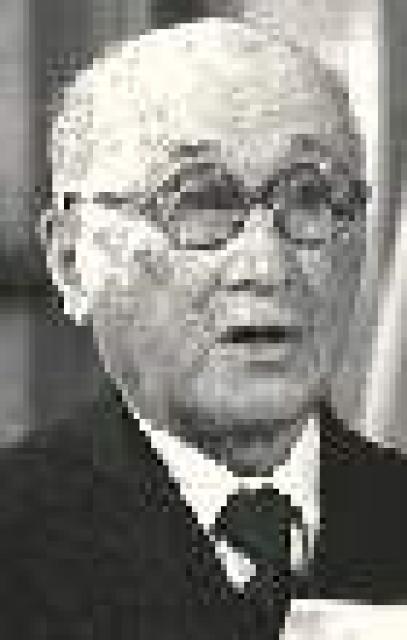
Jean Monnet
 France
- Jean Monnet: Architect of European Unity
- World War I and League of Nations
- Interwar Years
- World War II and the United States
- The European Community
- The Action Committee and European Integration
- Legacy and Recognition
Jean Monnet: Architect of European Unity
Early Life and Business CareerBorn in Cognac, France, in 1888, Jean Monnet left school at the age of 16 without a university degree. He traveled to London, where he studied business and English. His father's advice to "look out the window and talk to people" guided his lifelong approach to business and diplomacy. After working abroad for his family's cognac business, Monnet became a successful international financier.
World War I and League of Nations
In World War I, Monnet's business connections in France and Britain led him to propose a plan for coordinating Allied efforts. This plan earned him international recognition and, in 1919, he was appointed General Secretary of the newly formed League of Nations.
Interwar Years
Monnet assisted in the postwar economic recovery of Eastern and Central European countries. He also played a pivotal role in creating Bancamerica-Blair, a major bank in San Francisco. From 1934 to 1936, he advised Chiang Kai-Shek on reorganizing China's railway system.
World War II and the United States
During World War II, Monnet was authorized by the French government to negotiate the purchase of military aircraft from the United States. In 1939, he was sent to London to oversee the coordination of French and British arms production. After France's defeat in 1940, he represented the British Supply Council in Washington, D.C., where he became a confidant of President Franklin D. Roosevelt. Monnet convinced Roosevelt to initiate a massive armament program to supply the Allies and serve as the "arsenal of democracy."
The European Community
In 1943, Monnet joined the National Liberation Committee, the exiled French government in Algeria. He proposed a European federation to ensure the prosperity and social progress of European nations. After the liberation of France, he worked with Charles de Gaulle to implement a plan for economic modernization.
In 1950, Monnet issued the Schuman Declaration, proposing the pooling of French and German coal and steel production under a common authority. This proposal led to the creation of the European Coal and Steel Community (ECSC) in 1952, with Monnet serving as its first president.
The Action Committee and European Integration
After the failure of the European Defense Community (EDC) in 1955, Monnet founded the Action Committee for the United States of Europe. Led by his tireless energy, this committee advocated for the creation of a unified European state, including the Common Market, a common currency system, the Council of Europe, and the election of the European Parliament by universal suffrage.
Legacy and Recognition
Throughout his life, Monnet believed that European unity was essential for the survival of its nations. He died in 1979, leaving behind a legacy as a visionary and tireless advocate for European cooperation. His remains are buried in the Panthéon in Paris, and in 1976, he was declared an "Honorary Citizen of Europe" by the European Council.




