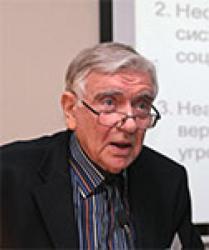
Jeffrey C Alexander
 USA
USA- Early Life and Education
- Academic Career
- Neofunctionalism and Cultural Sociology
- Contributions to Sociology
Early Life and Education
Jeffrey C. Alexander was born into a middle-class Jewish family with an entrepreneurial background. His paternal family immigrated to San Francisco from Poland during the Gold Rush in 1848, while his maternal grandmother hailed from Odessa, Ukraine. Growing up in Milwaukee, Alexander attended public high school and worked part-time jobs to supplement his family's income. Despite their status, his father insisted on instilling a strong work ethic and an understanding of "normal life."
Alexander excelled academically and became one of three students from his graduating class to be accepted into Harvard University in 1965. While at Harvard, he majored in sociology, drawn to the ideas of Michael Walzer, David Riesman, and Stanley Hoffmann. Influenced by the writings of Tocqueville, Weber, and Marx, he joined the "Students for a Democratic Society" (SDS) and actively participated in leftist student movements.
Academic Career
After graduating from Harvard with a bachelor's degree in 1969, Alexander enrolled at the University of California, Berkeley. Initially involved in radical politics, he gradually shifted his focus towards sociological theory, influenced by Weber and Durkheim. He collaborated with notable scholars such as Fred Block, Neil Smelser, Leo Lowenthal, and Robert Bellah.
In 1978, Alexander earned his Ph.D. from Berkeley and joined the faculty there. He remained at Berkeley until 2001, developing his theory of "neofunctionalism." In this approach, he integrated insights from conflict theory and phenomenology into Parsons' functionalism.
In 2001, Alexander moved to Yale University as the Lillian Chavenson Saden Professor of Sociology. He founded the Center for Cultural Sociology with Ron Eyerman and continues to lead the center today.
Neofunctionalism and Cultural Sociology
Alexander's early work focused on the development of "neofunctionalism," a theory that sought to address criticisms of structural-functionalism. Neofunctionalism emphasized the importance of cultural factors and social conflict in social analysis.
Later in his career, Alexander shifted his focus to cultural sociology, arguing for the central role of culture in understanding the social world. He incorporated insights from semiotics, structuralism, post-structuralism, and hermeneutics into his theoretical framework.
Contributions to Sociology
Jeffrey C. Alexander has made significant contributions to the field of sociology:
- Developed the theory of "neofunctionalism," a nuanced approach that integrates cultural and conflict elements into structural-functionalism.
- Pioneered cultural sociology, focusing on the role of culture in shaping social life.
- Founded the Research Committee on Sociological Theory within the International Sociological Association.
- Established the Center for Cultural Sociology at Yale University, a leading center for research on cultural phenomena.
- Published numerous influential books and articles on social theory, cultural sociology, and globalization.
Alexander's work has been widely recognized and has influenced scholars across the globe. He is a prominent figure in contemporary sociology, known for his innovative ideas and his dedication to advancing sociological understanding.