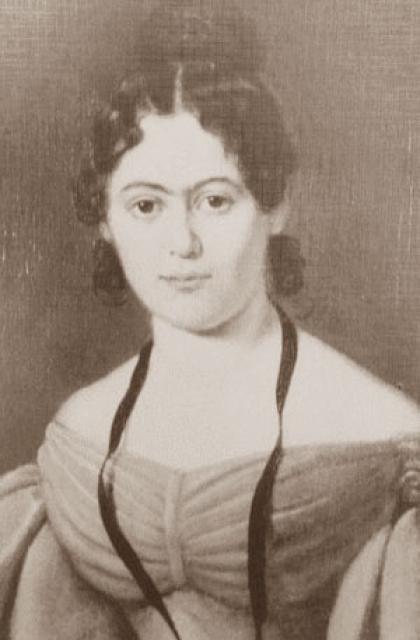
Jenny von Vestfalen
 Germany
Biography of Jenny von Westphalen
Jenny von Westphalen, the wife of Karl Marx, was born into the Prussian aristocracy. Her paternal grandfather was a counselor and secretary to Duke Ferdinand of Brunswick and later became his field marshal. Her grandmother belonged to the highest nobility of Scotland. Jenny's father, Ludwig von Westphalen, was a highly educated man who spoke multiple languages, had a deep appreciation for literature, and was considered a liberal in his social circle. Young Marx was influenced by the elder Westphalen and held him in the highest regard. In the dedication of his doctoral dissertation, Marx wrote, "To my dear father and friend... in token of filial love."
According to the German author Louisa Dornemann in her book "Jenny Marx," Jenny and Karl Marx's fathers were very close friends. Their children grew up together, playing in the gardens of the Westphalen family. When Karl turned twelve, he and Jenny's brother Edgar began attending boarding school together. Jenny turned sixteen, and her parents hoped that she would make a good match and secure a high social position. She enjoyed the carefree life of youth, filled with parties, masquerades, concerts, and picnics. Jenny loved dressing up and choosing fashionable outfits. However, fate had different plans for her.
When seventeen-year-old Karl entered the University of Bonn, where his father sent him, he was already in an unofficial union with his childhood friend. Enchanted by his strong personality, Jenny entrusted her fate to the aspiring student who was four years younger than her. Their relationship, unconventional for the time, forced the young couple to keep their engagement a secret. Only Karl's father and his sister Sophie, Jenny's closest friend, were privy to this secret.
In 1836, Karl, who had fallen into the category of politically "suspicious" students, was transferred to the University of Berlin with the help of his father. In March of the following year, Marx, who had not yet turned nineteen, asked for Jenny's hand in marriage. However, her family vehemently refused, and Jenny fell seriously ill due to the emotional distress. Marx returned to his university studies. In 1841, he received his doctorate degree. Despite his brilliant defense of his dissertation, Karl hoped to stay at the university to prepare for a professorship. But due to his involvement in "suspicious" philosophical circles and unfavorable comments about the university administration, he was denied this opportunity. As a result, German universities closed their doors to him. Marx found himself with nothing, leaving Jenny, who had sacrificed so much for him, with very little.
Jenny was deeply affected. At twenty-seven, she had considered herself engaged for six years, and society labeled her as a "spinster." She felt a deep divide between her and her former friends. After the death of Marx's father in 1838, the relationship between the two families became strained, almost closing the doors to Jenny in her beloved's home. Eventually, Marx returned to his hometown, and that alone seemed like happiness to Jenny. However, their difficult life continued. Karl's disagreements with his family escalated, and his mother, disapproving of his political views, showered him with justified reproaches, urging him to start earning money. Then, the elderly Westphalen fell seriously ill and passed away after three months of suffering.
Over the years, Jenny and Karl became even closer. Against her family's wishes, Jenny was determined to share Marx's fate, even in exile. Their modest wedding finally took place, followed by a honeymoon along the Rhine. The next urgent issue after their marriage was financial stability. Frau Marx, tired of financing her perpetually penniless son, angrily declared that she would not give him his share of the inheritance after her death. Karl initiated a legal battle that lasted for several years. With the help of his uncle, Dutch banker Leon Philips, he managed to obtain his rightful inheritance, finally achieving financial independence. However, money never seemed to stay in his hands for long.
Jenny's trials did not end with the start of her married life. Her husband, embarking on a tumultuous path as a journalist and democrat, traveled all over Europe. She courageously moved with Marx from one country to another, from one modest apartment to another, transforming from a glamorous baroness into an unpretentious companion to an exiled outcast. In February 1845, Marx was expelled from France at the request of the Prussian government. He left Paris alone. And Jenny? "Jenny had to settle the apartment matters and take on all the troubles and unpleasantness caused by the forced exile," writes biographer L. Dornemann.
As a spoiled daughter of wealthy parents who had never needed or dealt with household matters, Jenny experienced poverty and constant humiliation. For many years, they lived in destitution. The family survived on just potatoes for weeks, endured cold winters without coal, and couldn't afford a doctor or medicine when someone fell ill. Jenny engaged in constant battles with creditors. She had to beg the baker, butcher, and grocer for credit, often leading to unpleasant confrontations. She spent a lot of energy and nerves resolving conflicts with landlords, as the threat of eviction hung over the family. The pawnshop always provided a last resort, where they pawned not only unnecessary items but sometimes even Jenny's only skirt. When Karl was imprisoned in Brussels, and Jenny visited him, the police decided to frighten her and deceitfully locked her in a cell, where she spent the night alongside thieves and prostitutes.
Jenny avoided discussing her daily struggles with her husband, allowing him to focus on his scholarly work. In one of Marx's letters to his wife, he wrote, "You, however, should not hesitate to inform me about everything. If you, poor thing, have experienced all this in reality, then justice demands that I, at least in thought, experience all the torments with you." Compliments from Marx to his long-suffering wife were also unique: "As bad as your portrait is, it serves me well, and now I understand why even 'gloomy Madonnas,' the most ugly depictions of the Virgin Mary, could find zealous devotees."
Their deprivations tragically claimed the lives of three of Jenny's children: one-year-old Guido, little Franziska, and nine-year-old Edgar. The grief of a mother was immeasurable. Of their seven children (one died shortly after birth), only two daughters, Laura and Eleanor, survived. The family lacked the means to bury Franziska, to summon a doctor for Jenny and her eldest daughter, or to pay the bills. The head of the family had already sold his coat, and now it was time to sell the Westphalen family silver. However, when Karl went to sell the silver, he was arrested on suspicion of theft because he did not resemble a German aristocrat. Jenny, forgetting about herself and her daughters, had to rescue her husband from prison. This incident with the silver turned into a family anecdote.
There was another child of Marx's, born out of wedlock. This aspect of the founder of scientific communism's life was hidden from the broader public for a long time. His relationship with Frau Tenge, a thirty-three-year-old educated Italian woman and wealthy landowner, seemed to end without consequences. However, his affair with the housemaid Lenchen, who biographers wrote was practically a member of the family, resulted in the birth of a son, Henry Frederick. This child was raised by another family, and Marx only saw him once. Engels, unsurprisingly, provided invaluable assistance to his friend in this situation, taking on the "blame" for seducing Lenchen onto himself. But many years later, documents were found that proved that Freddy Demuth, adopted by Engels, was, in fact, Karl Marx's son. In 1863, Marx became infatuated with his niece Antoinette Philips, who was nineteen years younger than him.
How Jenny reacted to all this is not definitively known. How she reconciled with her beloved's other flaws is also unclear. One thing is evident: like her spouse, she expressed contempt for their longtime companion and Engels' civil wife, referring to her as nothing more than "that woman."
Engels, the son of a wealthy German industrialist who owned his own textile factory in Manchester, became a understanding friend and not only covered up his co-author's sins in the "Communist Manifesto." Starting in 1869, Friedrich supported Marx financially, allocating him seven thousand marks annually. However, Marx could no longer change his ways and continued to live beyond his means.
From the very beginning of their married life, Jenny took on the role of her husband's literary mentor: "Don't write so bitterly and irritably... Please, my dear, my beloved, let your pen freely glide on the paper..." Her professional advice was always accurate. But she corrected her husband's hand with tact and delicacy, caring above all to support, inspire, and invigorate him! She never wavered from this tone of their relationship.
Jenny transcribed most of Marx's manuscripts, preparing them for publication. Marx's handwriting was difficult to read, and even he sometimes struggled to decipher it. For many years, she worked on the fundamental foundations of Marxism in a dimly lit room after completing her household chores. Even in her later years, Jenny considered those hours "the happiest in her life."
The last years of her life were darkened by a painful illness: liver cancer. She selflessly concealed her pain to avoid causing suffering to her loved ones. Marx invited the most famous doctors in London to a consultation, but they were unable to help her. On December 2, 1881, Jenny Marx closed her eyes forever. Her last words were directed to her Karl.