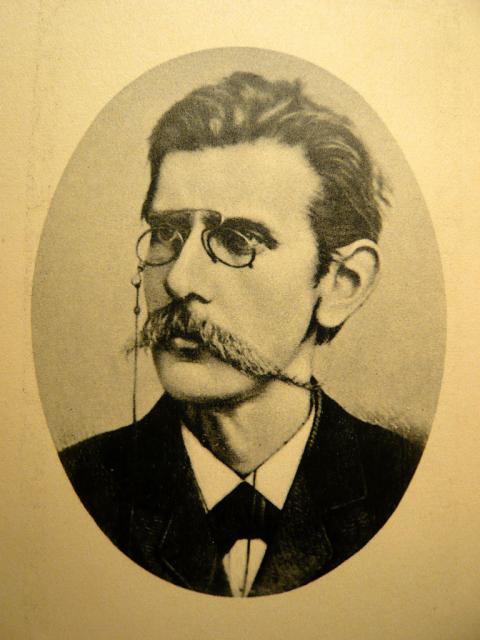
Jens Peter Jacobsen
 Denmark
Biography of Jens Peter Jacobsen
Jens Peter Jacobsen was a Danish writer, poet, and scientist, and is considered one of the founders of Danish literary naturalism. He was born in Thisted, Jutland, and was the eldest of five children of a wealthy merchant. Jacobsen attended school in Copenhagen and went on to study at the University of Copenhagen.
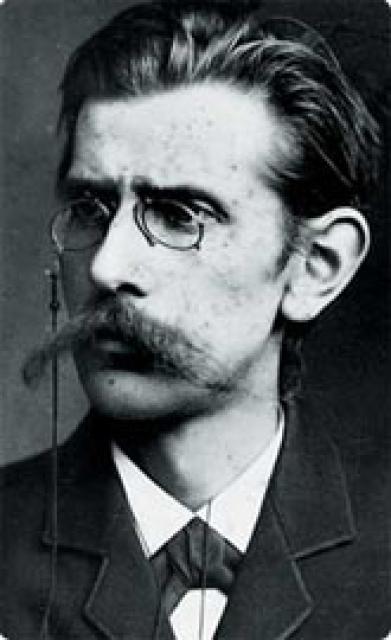
As a child, Jacobsen demonstrated exceptional talent in various sciences, particularly botany. He also had an interest in literature, and by 1870, he was already writing poetry. However, Jacobsen kept his passion for poetry a secret and chose to pursue a career in botany. He was sent by the Copenhagen scientific community to the islands of Anholt and Læsø.
Around the same time, Jacobsen became actively interested in the theories of Charles Darwin. Realizing that Darwin's works were virtually unknown in Denmark, Jacobsen translated "The Origin of Species" and "The Descent of Man, and Selection in Relation to Sex" into Danish.
In his youth, Jacobsen contracted tuberculosis, which ultimately took his life. Despite his relatively small body of work, he made a significant impact as one of Denmark's most prominent writers. His historical novel, "Marie Grubbe," was the first in Danish literature to portray a woman as a sexual being. The novel depicted the life of a Danish noblewoman in the 17th century who, due to her reckless pursuit of independence and a sexually fulfilling life, became the wife of an ordinary ferryman.
In some ways, Jacobsen's works can be seen as engaging in a dialogue with the writings of D.H. Lawrence. His second novel, "Niels Lyhne," published in 1880, depicted the difficult life of an atheist in the modern world. The protagonist's unbelief is tested through a series of trials, and he ultimately maintains it even on his deathbed.
Jacobsen's short stories were published in 1882 in a collection called "Mogens and Other Stories." The story "Mogens" was dedicated to a young dreamer and his coming of age, while "A Shot in the Fog" showed clear influence from Edgar Allan Poe's works. "The Plague in Bergamo" tackled the theme of religion and how people desperately cling to it in hopes of finding desired freedom. Renowned poet Rainer Maria Rilke highly praised Jacobsen's stories and the novel "Niels Lyhne" in his letters to Franz Xaver Kappus.
In his poetry, Jacobsen exhibited a strong influence from late Romanticism. Most of his poems were characterized by melancholy, contemplation, and dreaminess, while still maintaining a naturalistic tone. One of his most famous poems is "Arabesque to a Hand-drawing by Michel Angelo," in which Jacobsen reflects on how art replaces immortality. Jacobsen's work greatly influenced the development of symbolic poetry in Denmark.
Unlike many of his contemporaries, Jacobsen did not show a particular interest in politics. Instead, he was more fascinated by science in general and psychology in particular. His extraordinary artistic talent allowed him to create incredibly vivid descriptions in his writings.