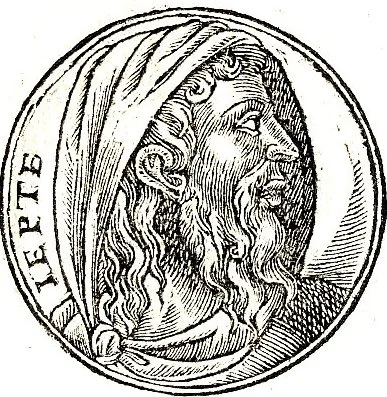
Jephthah
- Exile and Return
- The Conflict with Ammon
- The Vow and His Daughter
- Conflict with Ephraim and Later Life
- Legacy in Scripture and Tradition
Jephthah’s story in the Book of Judges moves from rejection to military command, then from victory to a vow with devastating consequences. Cast out by his family because of his birth, he returned as the man his community needed when the Ammonites threatened Gilead. The biblical narrative remembers him as a judge and warrior, but its most lasting episode is the vow he made before battle and the fate of his only daughter.
Exile and Return
Judges describes Jephthah as a Gileadite and the son of Gilead and a woman identified in the text as a prostitute. His half-brothers drove him away, telling him he would receive no inheritance in their father’s house. He settled in the land of Tob, where a group of men gathered around him and followed him.
When the Ammonites waged war against Israel, the elders of Gilead sought Jephthah out. They asked him to lead their forces, despite the earlier rejection. He agreed on the condition that, if he defeated the Ammonites, he would become their head. The elders accepted, and Jephthah returned to Gilead as a military leader.
The Conflict with Ammon
Before fighting, Jephthah sent messengers to the Ammonite king, asking why he had invaded Gilead. Their exchange became a dispute over territory and history. The Ammonite ruler claimed that Israel had taken land from Ammon during its journey from Egypt. Jephthah answered with a long account of Israel’s route through the region, arguing that the disputed territory had been taken from the Amorites, not Ammon.
He also insisted that Israel had not attacked Ammon or Moab. The message did not resolve the conflict. The biblical account says that the Spirit of the Lord came upon Jephthah before the battle, and his forces defeated the Ammonites, taking control of twenty towns.
The Vow and His Daughter
Before going to war, Jephthah made a vow to God. He promised that if he returned victorious, whoever came out from the doors of his house to meet him would belong to God and be offered as a burnt offering. When he arrived home in triumph, his only child, his daughter, came out dancing with tambourines.
Jephthah tore his clothes in grief and told her of the vow. She asked to spend two months in the hills with her companions, mourning that she would die unmarried. When she returned, the text says that Jephthah carried out the vow he had made. The passage is widely read as depicting the sacrifice of his daughter. Some later Jewish and Christian interpreters understood the outcome instead as a vow of lifelong virginity and dedication to religious service, but the plain sequence of the biblical story points to a fatal outcome.
The narrative says that women of Israel thereafter went out annually to commemorate Jephthah’s daughter for four days. She is given no personal name in the text, yet the account’s focus on her grief and acceptance has made her a central figure in later religious interpretation and art. The story presents Jephthah’s vow as a tragedy rather than an uncomplicated victory: his success in battle brings him home to an irreversible loss.
Conflict with Ephraim and Later Life
After the war, Jephthah’s conflict with the Ammonites was followed by an internal dispute. Men of Ephraim complained that he had not summoned them to fight and threatened his house. Jephthah replied that he had called for help, but the Ephraimites had not come. Fighting broke out between Gilead and Ephraim, and Jephthah’s forces prevailed.
In the account’s most striking detail, Gileadite guards controlled the crossings of the Jordan. They asked those trying to escape to pronounce the word “Shibboleth.” Those who pronounced it “Sibboleth” were identified as Ephraimites and killed. The Book of Judges says that forty-two thousand Ephraimites died in the conflict, a grim ending to the story of Jephthah’s leadership.
Jephthah judged Israel for six years. He died and was buried in Gilead, according to the biblical text. No independent historical record confirms the events of his life, and his biography is known through the religious narrative in Judges.
Legacy in Scripture and Tradition
Jephthah appears in a list of figures remembered for faith in the New Testament’s Epistle to the Hebrews, alongside Gideon, Barak, Samson, and David. In Jewish and Christian traditions, he has consequently been read in contrasting ways: as a deliverer who acted with courage, as a leader undone by rashness, and as a father whose vow brings catastrophe to his child.
His story remains challenging because it holds military success and moral failure together. Jephthah secures Gilead from its enemies, yet the account makes the cost of his promise impossible to ignore. The nameless daughter’s brief voice, her request to mourn, and the memorial custom that followed ensure that the story is not only about a warrior’s victory, but also about the human consequence of his vow.
