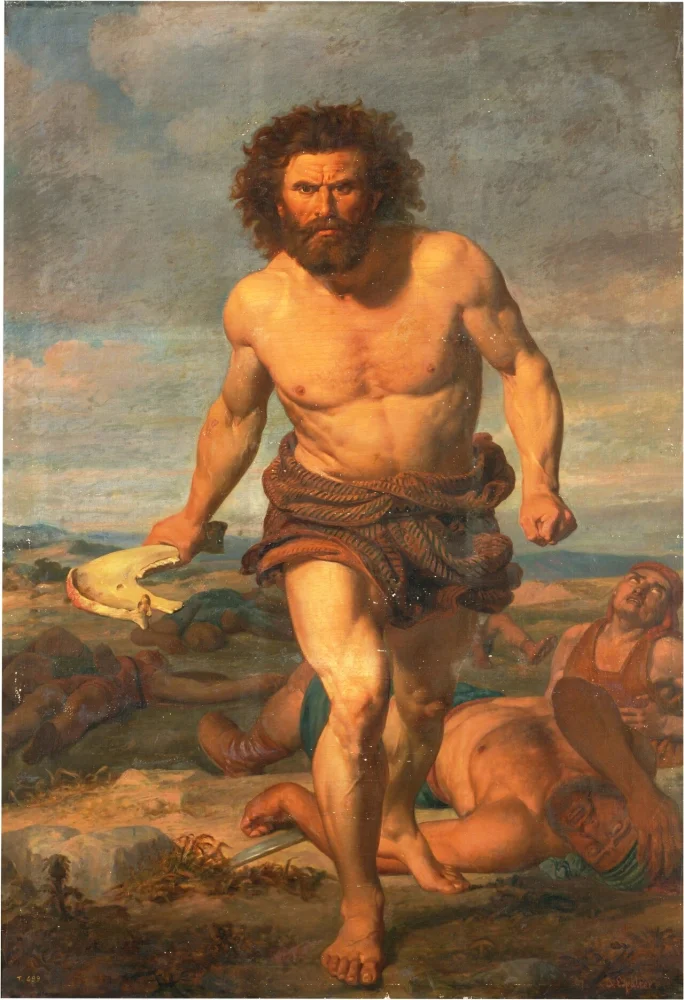
Samson
Samson is one of the Hebrew Bible’s most memorable judges: a man of extraordinary strength whose appetite for risk and desire repeatedly place him in danger. The Book of Judges tells his story as a cycle of stunning feats, personal betrayals, and a final act of destruction. Consecrated before birth, he becomes Israel’s champion against the Philistines, but his immense power never makes him master of his own choices.
A Promised Birth
Judges introduces Samson through an announcement to his mother, who had been unable to have children. A messenger tells her that she will give birth to a son who is to be a Nazirite from the womb, set apart for God. His hair is not to be cut, and he is destined to begin delivering Israel from Philistine control. His parents, Manoah and his wife, raise him in Zorah, in the territory associated with the tribe of Dan.
The story emphasizes that Samson’s strength is not simply a physical trait: when he confronts danger, the spirit of the Lord comes upon him. Yet the adult Samson often acts impulsively. He pursues a Philistine woman from Timnah, challenges wedding guests with a riddle, and later retaliates when the contest turns against him. His choices set off a chain of violent confrontations that pit him against the Philistines.
Feats and Conflicts
Samson’s exploits have the scale of legend. He tears apart a lion, escapes binding, and uses the jawbone of a donkey to defeat a large force of Philistines. Judges describes him as judging Israel for twenty years during the period of Philistine domination. He is a solitary fighter rather than a ruler who builds institutions; his resistance is powerful but personal, and his victories do not end the wider conflict.
His relationships repeatedly become vulnerabilities. After an encounter with a prostitute in Gaza, Samson falls in love with Delilah, who is approached by Philistine leaders seeking the secret of his strength. He gives her misleading answers several times, then reveals that his uncut hair marks his lifelong consecration. While he sleeps, Delilah arranges for his hair to be cut. The Philistines seize him, blind him, and imprison him.
The Final Act
At a public celebration in the temple of Dagon, the Philistines bring Samson out to entertain them. His hair has begun to grow again. He prays for strength one last time, braces himself against the temple’s supporting pillars, and brings the building down on himself and the gathered crowd. Judges says that he killed more Philistines in his death than during his life. The ending is both a triumph over his captors and a bleak conclusion to the story of a man whose gifts repeatedly came at a personal cost.
A Complicated Hero
The biblical account leaves Samson neither a simple role model nor a conventional military leader. He is appointed for a purpose, yet repeatedly crosses boundaries and places trust in people who betray him. His story has inspired art, literature, and music for centuries, most famously John Milton’s dramatic poem “Samson Agonistes” and Camille Saint-Saëns’s opera “Samson and Delilah.” Across these retellings, the enduring appeal lies in the same tension found in Judges: immense strength alongside human weakness, and a final victory that arrives only through sacrifice.
