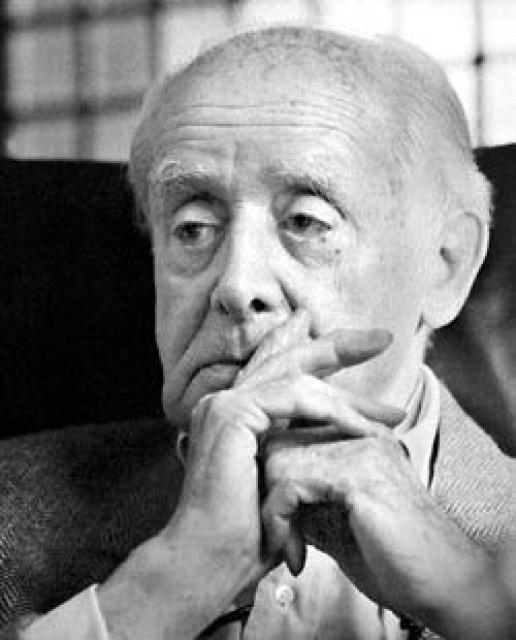
Jerzy Giedroyc
 Poland
- Biography of Jerzy Giedroyc
- Political Career and Exile
- The Giedroyc Prize: A Chance for Belarusian Writers
- Autobiography and Honors
Biography of Jerzy Giedroyc
Jerzy Giedroyc was a Polish and Belarusian publicist, politician, and memoirist. He was born into an ancient noble family of Lithuanian princes and completed his education at a lyceum in Warsaw. Giedroyc studied law (1924-1929) and history (1930-1931) at the University of Warsaw. He worked as a referent in the Ministry of Agriculture (1929-1935) and later headed a department in the Ministry of Industry and Trade (1935-1939).
Political Career and Exile
In 1930, Giedroyc became the editor of the weekly "Dzie? Akademicki" (an appendix to "Dzie? Polski"), which he soon transformed into "Bunt M?odych" ("The Rebellion of the Youth"), published twice a month. In 1936, the biweekly publication changed its name to "Polityka" and became an influential weekly magazine. With the outbreak of World War II, Giedroyc found himself in Romania, serving as the secretary to the Polish ambassador R. Raczy?ski (1939-1940). He then worked as the head of the Polish department at the Chilean embassy in Romania (1940) and later as a staff member at the British embassy in Bucharest (1941). Giedroyc participated in the Libyan campaign as a soldier in the Independent Carpathian Brigade and later served as the head of the press department at General Anders' corps headquarters (1941-1944). In 1945, he became the head of the European department of the Polish government's Ministry of Information in London.
The Giedroyc Prize: A Chance for Belarusian Writers
In 1946, Giedroyc founded the publishing house "Instytut Literacki" in Rome, which was later relocated to Maison Lafitte in 1947. From 1947 to 2000, the publishing house produced the monthly literary journal "Kultura," of which Giedroyc was the chief editor. The journal became a center of Polish political and social thought not only in the emigration but also in Poland, where it was distributed illegally. It featured works by Simone Weil, Albert Camus, T.S. Eliot, Emil Cioran, Jeanne Hébuterne, and other European intellectuals. The "Biblioteka „Kultury“" series published over 600 books, including translations of works by Andrei Sakharov, Aleksandr Solzhenitsyn, and other Russian authors. Giedroyc attracted prominent Polish emigrant writers and publicists such as Józef Czapski, Czesław Miłosz, Witold Gombrowicz, Gustaw Herling-Grudziński, Jerzy Stempowski, Zygmunt Haupt, Andrzej Kijowski, and others to contribute to the publishing house and journal. Aside from "Kultura," Giedroyc also oversaw the publication of the quarterly journal "Zeszyty Historyczne" ("Historical Notebooks") in Paris from 1962, which featured materials on the recent history of Poland and neighboring countries (Latvia, Lithuania, Russia, Ukraine), including analytical articles, document publications, and memoirs. He was also a member of the editorial boards of the Russian emigrant journal "Kontinent" and the Ukrainian journal "Vidnova."
Autobiography and Honors
Giedroyc authored the memoir "Autobiografia na cztery r?ce" (1994). He received various awards and honors during his lifetime, including the Officer's Cross of the Romanian Crown (1930), the Estonian Order of the White Star (1932), the Officer's Cross of the Legion of Honor (1996), and the Lithuanian Order of the Grand Duke Gediminas (1998). He was the only person who declined to accept Poland's highest honor, the Order of the White Eagle, in protest against the deteriorating situation in the country after 1989. Giedroyc was awarded honorary doctorates from Jagiellonian University (1991), the University of Wrocław (1998), the University of Warsaw (1998), and the Maria Curie-Skłodowska University in Lublin (2000). He was also made an honorary citizen of Lithuania (1997). The Polish Parliament declared the year 2006 as the Year of Jerzy Giedroyc, and his 100th birthday was included in the list of commemorated dates under the auspices of UNESCO.


