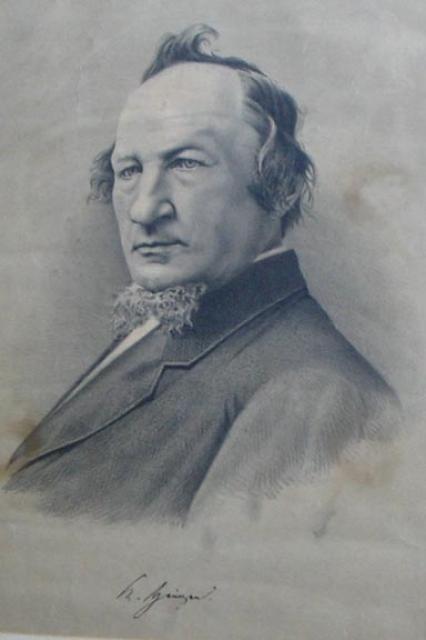
Karl Geytsen
 Germany
- Biography of Karl Heinzen
- Radical Views and Publications
- Criticism and Controversy
- Philosophy of Violence and Legacy
Biography of Karl Heinzen
German publicist, leader of the Baden Revolution, agitator, and advocate for radical transformation of Europe on republican principles. Karl Peter Heinzen, born on February 22, 1809, was a German publicist, leader of the Baden Revolution, agitator, and advocate for radical transformation of Europe on republican principles. He gained recognition as a publicist after his involvement with the "Leipziger Allgemeine Zeitung" and "Rheinische Zeitung". Having experience as a civil servant, he published the monograph "Prussian Bureaucracy" (Die preussische Bureaukratie) in Darmstadt in 1845. After conflicts with the local bureaucracy, Heinzen and his friend Gustav von Struve emigrated to England. From there, Heinzen relocated to the United States.
Radical Views and Publications
Initially planning to establish a women's school, Heinzen instead published a radical journal, known as "Pionier" (Pioneer). He also released "Gesammelten Schriften" in Boston. Heinzen held radical positions regarding the transformation of a fragmented Germany into a republican federation of autonomous states. His main mistake was his belief that the establishment of a democratic republic would automatically solve the economic problems of Europe in the 1840s. Alexander Herzen, in his memoirs "My Past and Thoughts," referred to Heinzen as the "Sobakevich of the German Revolution." Among the Russian emigration, Heinzen's reputation was based on his "cannibalistic escapades," particularly his public statement about the need to "beat two million people on the face of the earth - and the revolution will go smoothly," as retold by Herzen. However, Herzen also believed that the polemics between Karl Heinzen and Karl Marx involved ethical violations.
Criticism and Controversy
Heinzen's views faced criticism from Stefan Born (also known as Simona Buttermilch), a member of the Communist League and a worker typesetter, who published the pamphlet "The State of Heinzen" in Bern in 1847. Friedrich Engels and Karl Marx responded with a pamphlet, "Communists and Karl Heinzen," published in the "Deutsche Brüsseler Zeitung" (Brussels). Engels was compelled to write this pamphlet after Heinzen attacked the communists on September 26, 1847, in support of the "revolutionaries". According to Engels, Heinzen's monograph "Prussian Bureaucracy" (1845) was secondary compared to Jakob Venedey's book "Prussia and Prussianism" (1839). Heinzen continued the escalating debate and, on October 21, 1847, issued a "Manifesto" (Em "Reprasentant" der Kommunisten). After receiving offensive responses from Heinzen in an article titled "Representative of the Communists," Marx summarized the dispute in his pamphlet "Moralizing Criticism and Critical Morality" (1847). Marx compared Heinzen's political position to the rhetoric of the ruling prince of the German state of Reuss, Henry LXXXII Reuss-Lobenstein-Ebersdorf.
Philosophy of Violence and Legacy
Heinzen harbored hatred towards monarchical power and believed that the communists were "trying to protect monarchs from danger through revolutionary fireworks." Due to his radical worldview, Heinzen became one of the creators of the so-called "philosophy of the bomb." His journalistic efforts aimed to debunk the moral prohibition on multiple killings in political struggle. Heinzen's most resonant article, "Murder" (1849), argued for the relativity of morality, dismissing it as an outdated concept in light of the expediency of targeted assassinations against the ruling authorities. In particular, regarding the conflict between revolutionaries and the government, he stated: "Their slogan is murder, our response is murder. They require murder, and we pay in the same coin. Murder is their argument, and in murder lies our refutation." Among his calls for maximum chaos, Heinzen's militant views included predictions of poisonous gas and rockets capable of hunting down individuals. Long before Nietzsche and Hitler, Heinzen wrote, "If we need to strike half the continent or shed seas of blood... our conscience will not torment us." Heinzen's concepts found logical development in the theories of Mikhail Bakunin and Peter Kropotkin, who proposed the doctrine of "propaganda by action." Today, practitioners, theorists, and researchers on the issue of violence recognize Heinzen as the founder of the theory of modern terrorism. "There is no more important social issue than the question of monarchy and republic." He believed that "violence serves as the starting point for historical development," and that communists "only understand politics when it enters or exits the factory."


