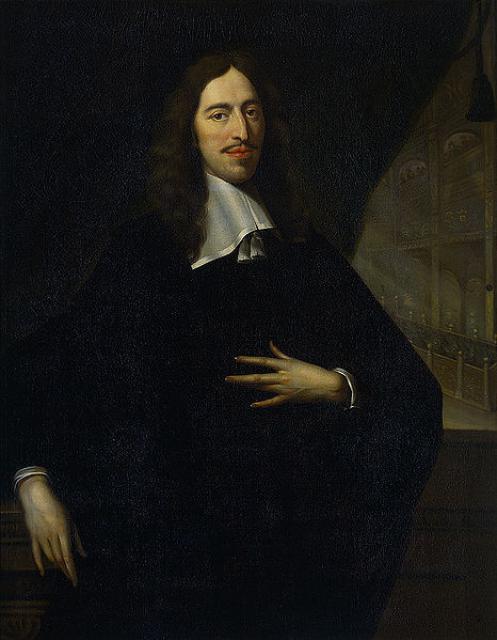
Johan de Witt
 Netherlands
Biography of Johan de Witt
Johan de Witt was a Dutch statesman who served as the Grand Pensionary of the province of Holland in 1653. For 20 years, he effectively ruled the Dutch Republic and defended its positions in trade and colonial conflicts with England, which resulted in two wars between the two countries.
Early Life and Education
Johan de Witt was born into a family of merchants and politicians in Dordrecht. His father was the Burgomaster of the city and represented it in the States General of the Dutch Republic. The de Witt family shared the views of the merchant oligarchy, which advocated for strengthening the administration of the states at the expense of the federal government, led by the House of Orange.
During his studies at Leiden University, Johan excelled in mathematics and law. He even wrote one of the first textbooks on analytic geometry titled "Elementa curvarum linearum." His profound knowledge of mathematics later allowed him to easily handle the financial and budgetary issues of the republic.
Career and Achievements
In 1645, Johan and his brother Cornelis embarked on a journey through Western Europe. Upon his return, he settled in The Hague and worked as a lawyer. In 1650, he inherited his father's position as Pensionary of Dordrecht and went on to represent the city's interests in the federal government. However, debates with the Stadtholder William II, during which de Witt and other regional pensionaries defended the autonomy of the states, ended with their imprisonment in the Loevestein Castle.
The unexpected death of the Stadtholder shortly before the birth of his successor, William III, unleashed opposition forces and allowed de Witt to seize control of the government. His goal was to strengthen Holland within the republic and remove the House of Orange from power. At the age of 28, he was elected as the Grand Pensionary and was reelected to the position three times in 1658, 1663, and 1668.
When de Witt came to power, the First Anglo-Dutch War was in full swing, causing significant damage to the republic's economy. Rejecting Cromwell's excessive demand for a union between England and Holland, de Witt managed to negotiate the Westminster Peace Treaty in 1654 by accepting the Navigation Act.
Later Years and Legacy
After signing the peace treaty, de Witt focused on restoring the republic's finances and expanding its trade and colonial activities in the East Indies. In 1658, he supported Denmark in its actions against Sweden and, four years later, concluded the Treaty of The Hague on favorable terms with Portugal, which was allied with England.
However, relations with England deteriorated due to the restoration of the Stuarts, who demanded the appointment of William of Orange as Stadtholder or at least Captain-General. De Witt's government strongly opposed this appointment, leading to the outbreak of the Second Anglo-Dutch War in 1665. Thanks to his diplomatic efforts, the war ended with the Breda Peace in 1667, maintaining the status quo and allowing de Witt to declare the Netherlands a republic "for eternity" in the same year.
In January 1668, de Witt achieved another major diplomatic success. When Louis XIV attempted to occupy the Spanish Netherlands during the Devolution War, de Witt negotiated a Triple Alliance with England and Sweden. However, this victory angered Louis XIV, who blamed the Dutch for his failures and accused them of ingratitude for French support during the Dutch Revolt.
In 1672, Louis XIV unexpectedly invaded the United Provinces, leading to the Dutch War with France. The people demanded that all governing powers be transferred to William of Orange, holding de Witt's government responsible for the occupation. Under pressure from Orangeists, Johan had to resign as Grand Pensionary on August 4th. Upon learning that his brother Cornelis would be tortured, Johan hurried to The Hague to meet him. However, the Orangeists incited a mob against the brothers. Both were killed, their bodies mutilated, and displayed to the public. This event was later depicted in Alexandre Dumas' novel "The Black Tulip." Thus, one of the greatest statesmen in Dutch history met his tragic end. The year of his death became known as the "Year of Disasters" in the national history.
Today, statues of Johan de Witt can be found in several cities in the Netherlands, commemorating his contributions to the country.


