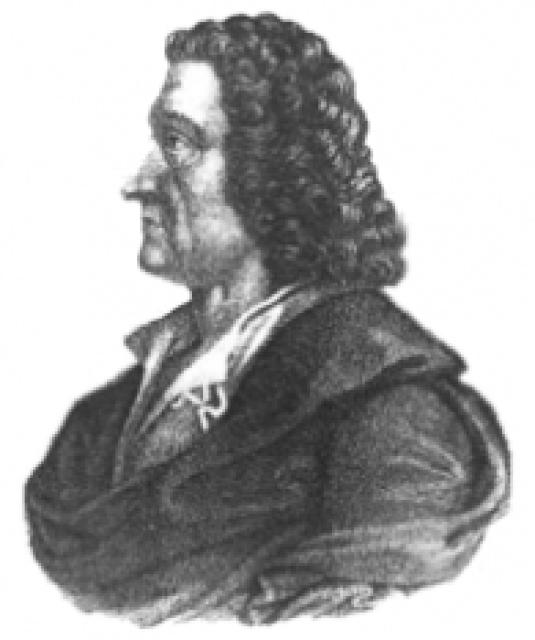
Johann Friedrich Bottger
 Germany
- Early Life and Alchemical Pursuits
- Royal Imprisonment and Escape
- Gold Alchemy and the Pursuit of Wealth
- Captivity and Discovery of Porcelain
- Birth of Red Porcelain
- White Porcelain: A Revolutionary Discovery
- Establishment of the Meissen Porcelain Manufactory
- Protection and Legacy
- Interesting Facts
Johann Friedrich Böttger: German Alchemist and Inventor of European Porcelain
Early Life and Alchemical Pursuits
Johann Friedrich Böttger, the son of a minor official, was born on February 4, 1682, in Schleiz, Saxony, Germany. His grandfather, a jeweler and coin expert, influenced his early education. Böttger's father, also a coin collector, instilled in him a deep knowledge of metallurgy.
In 1698, at the age of 16, Böttger apprenticed with the famous Berlin pharmacist Zorn. During this time, he became fascinated with alchemy, seeking to discover the philosopher's stone, a substance believed to heal all diseases and transmute base metals into gold.
Royal Imprisonment and Escape
Böttger's alleged transmutation of silver coins caught the attention of King Frederick I of Prussia, who ordered his capture. However, alerted by his master, Böttger fled to Wittenberg, where his uncle resided. Despite Frederick's demands, the Saxon Elector, Augustus the Strong, claimed Böttger as his subject due to his Saxon heritage. Böttger willingly traveled to Dresden, seeking royal patronage.
Gold Alchemy and the Pursuit of Wealth
Augustus, eager to secure gold to strengthen his power, employed Böttger and other alchemists to produce the precious metal. Böttger's demonstration of mercury transmutation into gold earned him the title of baron, but his extravagant lifestyle and failure to deliver on his promises led to his arrest in 1701.
Captivity and Discovery of Porcelain
Imprisoned in the "Golden House," Böttger was forced to experiment with gold production. In 1704, he was transferred to Königstein Fortress, where he encountered Count Erhard von Tschirnhaus, a renowned mathematician, physicist, and glass manufacturer.
Von Tschirnhaus recognized Böttger's potential and encouraged him to pursue scientific experimentation. Together, they explored potential ceramic materials in Saxony to create refractory crucibles and glass-making furnaces.
Birth of Red Porcelain
By 1705, Böttger and von Tschirnhaus had developed "rothes Porcelain," a red (jasper) porcelain characterized by its opacity, hardness, and non-porous structure. This porcelain was made from a red clay rich in iron oxides and was often polished to resemble precious stone carvings.
White Porcelain: A Revolutionary Discovery
Continued experimentation, funded by Augustus, led to the discovery of the ideal ingredients and firing conditions for white porcelain. On January 15, 1708, Böttger and von Tschirnhaus produced unglazed white porcelain biscuits, marking the birth of European hard-paste porcelain.
Establishment of the Meissen Porcelain Manufactory
With the death of von Tschirnhaus in 1708, Böttger took over as director of the newly established Meissen porcelain manufactory in 1710. The factory produced glazed white porcelain, jasper porcelain, and stone porcelain of the highest quality.
Protection and Legacy
Böttger's discovery of European porcelain guarded as a state secret. He remained under surveillance until his death on March 13, 1719, due to the toxicity of his alchemical experiments. Böttger's grave at the St. Johannis Cemetery in Dresden has been lost to time.
Interesting Facts
Legend has it that Böttger discovered Saxon kaolin when he noticed that his wig powder formed lumps and felt greasy. The kaolin was supplied by a merchant from Auer, and its properties proved to be comparable to Chinese kaolin.
The inscription on the door to Böttger's laboratory read: "God, our Creator, has made a potter out of a goldsmith."
The Böttger stoneware, reproducing the composition of his red porcelain, was revived in 1918.
In 1982, the Meissen manufactory issued a commemorative medal made of red Böttger stoneware to mark the 300th anniversary of his birth.