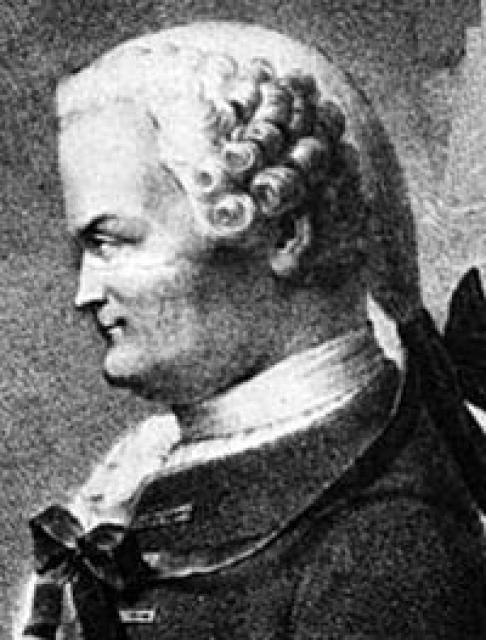
Johann Heinrich Lambert
 Germany
- Biography of Johann Heinrich Lambert
- Contributions to Astronomy
- Contributions to Mathematics
- Philosophical Endeavors
- Legacy and Death
Biography of Johann Heinrich Lambert
Johann Heinrich Lambert, a German physicist, philosopher, mathematician, and astronomer, was born on August 26, 1728, in Mülhausen. He is best known for his contributions to the fields of physics and astronomy. Lambert authored two fundamental and closely related works that have left a lasting impact on the history of science.

Contributions to Astronomy
In his first major work, "Photometria," Lambert developed the theoretical foundations of photometry, which is one of the key methods in observational astronomy. This work revolutionized the way astronomers measure the brightness of celestial objects.
Lambert's second significant contribution to astronomy was his work titled "Cosmological Letters on the Arrangement of the Universe." This masterpiece represents the pinnacle of Lambert's achievements as a natural philosopher. In this work, he delved into the structure and organization of the cosmos, exploring profound questions about the universe.
Contributions to Mathematics
In addition to his contributions to astronomy, Lambert made notable contributions to mathematics. He provided a proof of the irrationality of the number Pi, improved various geodetic methods, and conducted research on engines and friction.
Lambert also had an idea for a universal language of signs, which he called "semiotics." Although this concept did not gain widespread recognition during his lifetime, it demonstrated his innovative thinking and interdisciplinary approach to knowledge.
Philosophical Endeavors
In 1764, Lambert published an extensive philosophical work on critical philosophy. Immanuel Kant, who corresponded with Lambert, held a high opinion of his intellectual prowess. While Kant noted Lambert's lack of experience in metaphysical speculations, he had great expectations for their collaboration in the field of philosophy. Kant was deeply saddened by Lambert's premature death, as he saw great potential in their partnership.
Legacy and Death
Johann Heinrich Lambert passed away on September 25, 1777, in Berlin at the age of 49. Despite his relatively short life, Lambert's contributions to the fields of physics, astronomy, mathematics, and philosophy continue to be appreciated and studied today. His works have left a lasting impact on the development of these disciplines, making him a revered figure in the history of science.