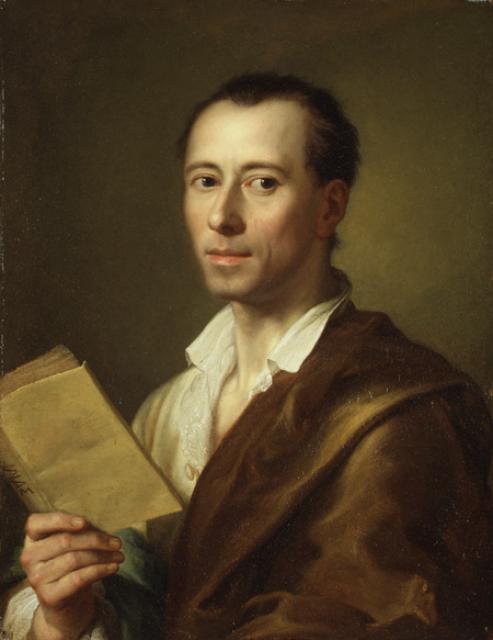
Johann Winckelmann
 Germany
Biography of Johann Winckelmann
Johann Winckelmann was a German art historian and archaeologist, considered the founder of modern ideas about ancient art and the science of archaeology. Despite being born into poverty as the son of a shoemaker, Winckelmann managed to complete his education at a gymnasium in Berlin and attended the university in Halle, where he primarily studied ancient literature.
Afterwards, he worked as a private tutor for various families before studying medicine at the University of Jena from 1743 to 1748. He then taught at a school near Berlin before becoming a librarian for Count Bünau in Nöthnitz, where he lived near Dresden and had the opportunity to frequently see and study the art treasures collected there. This experience ignited his passion for classical antiquity and his distaste for the rococo style that dominated German architecture and sculpture at the time.
Desiring to visit Rome and acquaint himself with its monuments, Winckelmann began negotiations with the papal nuncio, Arcinto, to secure a position at Cardinal Passionei's library. However, it was a condition for this position that he convert from Lutheranism to Catholicism. After five years of hesitation, Winckelmann made the important decision to convert in 1754 and the following year, he found himself in Rome.
In Rome, he became close friends with the painter Raphael Mengs, who shared his aesthetic beliefs and aspirations, and devoted himself entirely to the study of antiquities. After enriching his knowledge and broadening his perspectives with a trip to Naples and visits to Herculaneum and Pompeii, which had recently been excavated from the ashes of Mount Vesuvius, Winckelmann compiled a catalog of Baron Stosch's gem collection in Florence. He then embarked on the publication of his main work, "The History of Ancient Art," which was released in 1764. Shortly thereafter, he supplemented it with "Notes on the History of Art" in 1767, which was later translated into French and other languages.
After another trip to Naples, he set off for Germany with the sculptor Cavaceppi, but only made it as far as Vienna before returning to Italy. Near Trieste, Winckelmann accidentally met a recently released criminal named Arcangeli. Pretending to be an art enthusiast, Arcangeli gained his trust with the intention of taking advantage of the medals and money he had acquired. In Trieste, where Winckelmann planned to board a ship to Ancona and stayed for several days, he spent a night with Arcangeli, who then killed the great scholar in bed and robbed him of his belongings.
According to Winckelmann's great biographer, Johann Joachim Eschenburg, his predecessor in the field of art was the French connoisseur, Count Caylus. Winckelmann's main contribution lies in being the first to pave the way for understanding the cultural importance and beauty of classical art, reviving interest in it among the educated society. He not only founded the history of art but also artistic criticism, for which he proposed a coherent yet outdated system. His discovery of the sequence of styles in ancient art was closely linked to his rejection of the baroque and rococo styles compared to the art of the High Renaissance. This change in taste was evident to him everywhere, including the study of ancient art, and helped him dissect them into historical stages.
According to Winckelmann, the main goal of art should be "beauty," which encompasses individual truth, action, and effect. The essence of beauty lies in the depiction of an idealized type created by our imagination and nature. It is based on the principles of proportion, noble simplicity, serene grandeur, and harmonious contours. He taught that there is only one beauty that transcends time, as it is inherent in nature and realized where heavenly grace, the beneficial influence of political freedom, and national character coincide, such as in the works of Phidias and Praxiteles during the time of the ancient Greeks. For him, the art history of other nations served merely as a backdrop to make this truth shine brighter.