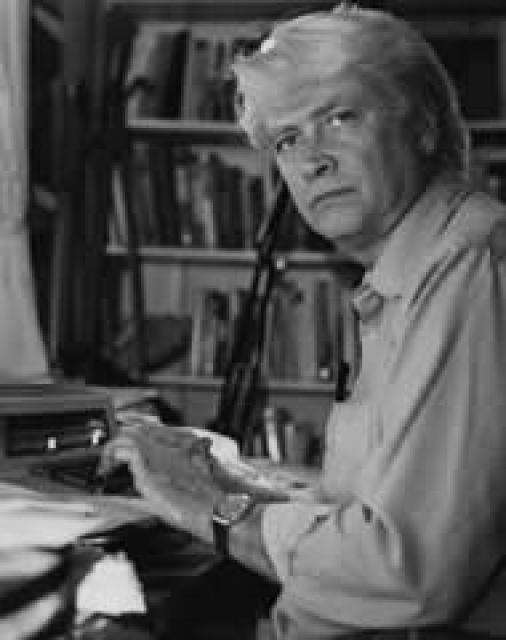
John Champlin Gardner
 USA
USABiography of John Champlin Gardner
John Champlin Gardner was an American writer best known for his novel "Grendel," a retelling of the myth of Beowulf. He was born into a family of a preacher and an English teacher. From a young age, he showed an interest in literature and music. In 1951, Gardner enrolled in the private university of DePauw, which had a strong focus on art and music in its program. Although he initially studied chemistry, he soon switched to literature. In 1953, after getting married, he transferred from DePauw University to the University of Washington (St. Louis), where he completed his degree two years later. In 1956, he received a Master of Arts, and in 1958, a Ph.D. from the University of Iowa. Afterward, he taught medieval literature and the fundamentals of creative writing at various colleges. In 1961, he co-authored the textbook "Forms of Fiction." In the 1960s, Gardner published several literary articles. He continued to publish monographs on literary criticism, including a work on the Wakefield Mystery Cycle in 1974 and a book on Chaucer's poetry in 1977. He had a particular interest in the epic poem "Beowulf" and conducted numerous seminars on it at different universities.
In the mid-1970s, Gardner was diagnosed with rectal cancer, which made it difficult for him to continue working by the beginning of the 1980s. Despite this, in 1980, he remarried a colleague from the State University of New York, Liz Rosenberg. The couple relocated to Susquehanna, Pennsylvania, where they continued their work at the university's branch. However, in 1982, they separated due to Gardner's affair with the writer Susan Shreve. Just two weeks before the planned wedding with Shreve, Gardner died in a car accident. After his death, two guidebooks for aspiring writers that he had written were published: "The Art of Fiction" and "On Becoming a Novelist." In 1965, Gardner's translation of "The Complete Works of the Gawain-Poet" was released.
In 1971, a collection of Gardner's translations of medieval English poems, including "The Death of Arthur," was published. From 1974, Gardner devoted himself to studying the Epic of Gilgamesh and started a verse translation of this epic adapted for a wide audience in 1976. He completed this work in 1982, shortly before his death.
In 1975, Gardner's collection of adapted classic works for children, "Dragon, Dragon and Other Tales," was recognized as the "New York Times" "outstanding book of the year." Gardner's first two novels, "The Resurrection" and "The Wreckage of Agathone," received more critical than positive reviews. Time magazine described the latter, set in ancient Sparta, as "more hysterical than historical." However, Gardner's breakthrough came with the publication of "Grendel," which retells the story of "Beowulf" from the perspective of the monster, giving it more human characteristics. "Grendel" was named one of the best literary works of the year by Time and Newsweek magazines in 1971.
Thanks to the success of "Grendel," Gardner was able to publish his earlier novel "The Sunlight Dialogues," which received high praise and remained on the New York Times bestseller list for 16 weeks. His novel "October Light" received the National Book Critics Circle Award in 1976.
In 1978, Gardner's controversial essay "On Moral Fiction" was published, in which he argued against subjective philosophical-aesthetic concepts in contemporary literature. According to Gardner, true art is moral and strives to make life better, resisting entropy and chaos and affirming concepts of goodness, truth, and beauty as "relative absolute values." He believed that literature should deal with the relationships between living people, but modern writers had pushed human character and moral positions of characters into the background, focusing on linguistic technique. However, Gardner's own novels were characterized by a postmodern, experimental style, which he criticized in his programmatic essay.
Gardner's works have been translated into Bulgarian, Hungarian, Mongolian, German, Polish, Russian, Serbian, Slovak, French, Croatian, Czech, and Japanese. His scientific and literary activities brought him numerous awards and prizes:
1972 - National Education Association Award
1973 - Denfor Foundation Fellowship
1974 - Guggenheim Fellowship
1976 - National Book Critics Circle Award for "October Light."


