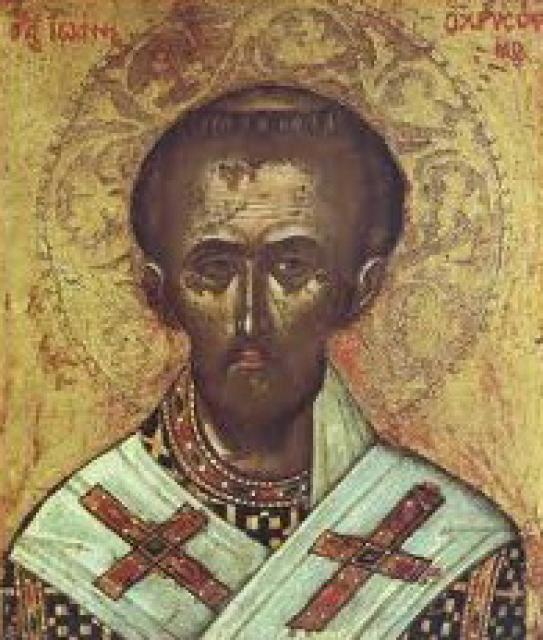
John Chrysostomos
 Greece
Biography of John Chrysostom
John Chrysostom, also known as Ioannes Chrysostomos, was a renowned orator and Greek Christian writer, widely recognized as one of the Fathers of the Church. He was born in Antioch around 350-407 AD.
Education and Early Life
After the death of his father, John received a profound education from his mother. He went on to study rhetoric under Libanius, philosophy under Andragathius, and theology under Diodorus of Tarsus. In 386 AD, he was ordained as a priest, and in 397 AD, he became the bishop of Constantinople.
Struggles and Exile
In 401 AD, John had his first conflict with Empress Eudoxia when he publicly criticized her love for luxury and injustice. In 403 AD, he was deposed from his position as bishop and banished during the Synod of the Oak. Although a brief public uprising reinstated him temporarily, he was once again exiled in 404 AD.
Legacy and Works
John Chrysostom passed away in exile in the Crimean Mountains. His significance can be observed through the preservation of almost all his works. His writings can be classified into three categories: speeches, treatises, and letters. The first group consists of 152 homilies, explaining books from the Old Testament (such as Genesis, Psalms, and Isaiah) and 468 compositions related to the New Testament, including commentaries on the Gospel of Matthew, the Gospel of John, the Acts of the Apostles, and all the letters of Paul. These works hold immense importance for the interpretation of the Bible.
Included in this group are also speeches addressing moral issues (such as games and repentance), speeches for church holidays, and speeches on various occasions (about statues, Eutropius, etc.), as well as panegyrics honoring biblical figures, saints, and bishops of Antioch. John Chrysostom's speeches and homilies, written in a lively and straightforward manner, yet with great rhetorical skill, earned him the nickname "Chrysostom" (Golden Mouth) in the 5th century AD.
His treatises focus on moral problems, including monastic life, virginity, education, and suffering. One of his famous treatises is "Peri hierosynes" about the priesthood. Additionally, there are 236 extant letters written by John Chrysostom to various recipients. However, many works (especially speeches) have been wrongly attributed to him.
John Chrysostom's influence on future generations was significant, and he was even called the "Christian Demosthenes". His works were translated into numerous languages, cementing his position as a highly esteemed figure in Christian literature.