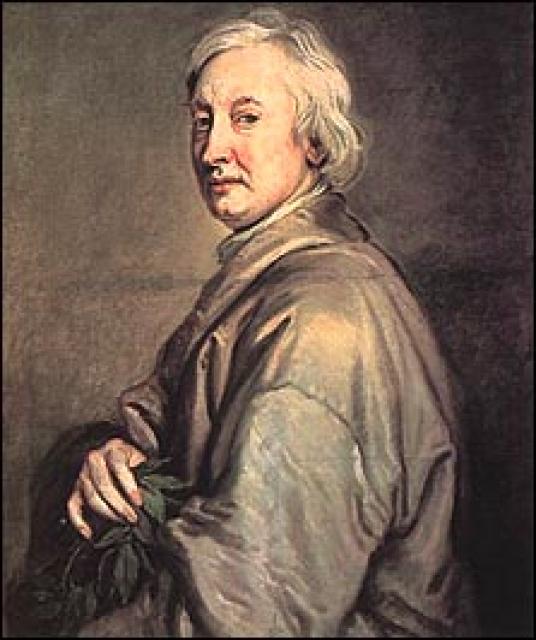
John Dryden
 Great Britain
- John Dryden: The Literary Icon of the Restoration Era
- Early Career and Restoration of the Monarchy
- Dramatic Success
- Annus Mirabilis and Poet Laureateship
- Satirical and Religious Controversies
- Later Years and Translations
- Literary Legacy and Death
John Dryden: The Literary Icon of the Restoration Era
Early Life and EducationJohn Dryden was born on August 19, 1631, in Aldwincle, Northamptonshire. His grandfather was a parish minister, and his father, a baronet and Justice of the Peace. Dryden received his early education at Titchmarsh, before attending Westminster School in London. In 1650, he entered Trinity College, Cambridge, where he studied classics, rhetoric, and mathematics.

Early Career and Restoration of the Monarchy
Upon graduating in 1654, Dryden worked for John Thurloe, Secretary of State under Oliver Cromwell. However, after the Restoration of the Monarchy in 1660, Dryden switched his allegiance to the new regime. He published "Astraea Redux," a panegyric praising the return of King Charles II, and quickly established himself as a leading poet.
Dramatic Success
Following the lifting of Puritan restrictions on theater, Dryden began writing plays. His first, "The Wild Gallant," was not well-received, but he later achieved success with comedies of manners such as "Marriage à la Mode" and heroic tragedies like "All for Love." Despite his commercial success, Dryden often expressed disdain for his theatrical works.
Annus Mirabilis and Poet Laureateship
In 1667, Dryden published "Annus Mirabilis," an epic poem commemorating the naval Battle of Lowestoft and the Great Fire of London. The poem's critical acclaim solidified Dryden's position as the preeminent poet of his generation and led to his appointment as Poet Laureate in 1668.
Satirical and Religious Controversies
Dryden was also a master of satire. His iambic pentameter poem "Mac Flecknoe" mercilessly attacked the playwright Thomas Shadwell. Dryden's religious beliefs also sparked controversy. In 1688, he wrote "Britannia Rediviva" to celebrate the birth of King James II's heir, but his refusal to swear allegiance to James's successor after the Glorious Revolution led to his dismissal from his court posts.
Later Years and Translations
Out of favor with the new regime, Dryden devoted his later years to translations. He translated works by Horace, Juvenal, Ovid, Lucretius, and Theocritus. His translation of "The Works of Virgil" (1697) was an acclaimed national event.
Literary Legacy and Death
John Dryden died on May 12, 1700. He was initially buried in a Soho churchyard but was later exhumed and reburied in Westminster Abbey. Poet Walter Scott dubbed Dryden the "Glorious John," a testament to his profound impact on English literature.





