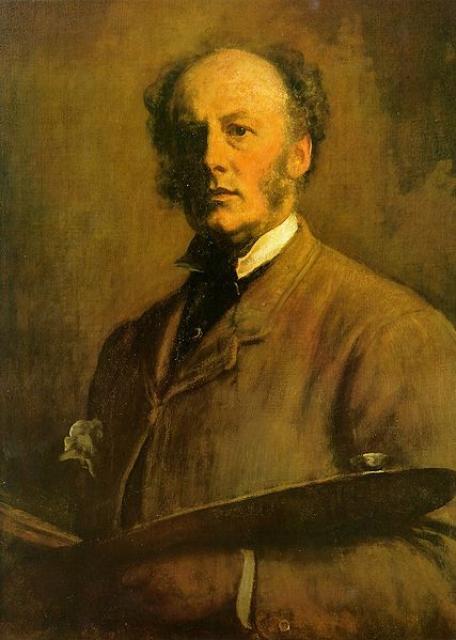
John Everett Millais
 Great Britain
Biography of John Everett Millais
John Everett Millais was a prominent English painter and one of the founders of the Pre-Raphaelite Brotherhood. He was born in Southampton and began studying art at the age of nine. In 1838, when his talents became apparent, his family moved to London. At the age of 11, Millais enrolled at the Royal Academy of Arts, becoming the youngest student in the history of the Academy. By the age of fifteen, he had mastered the art of painting, and in 1846, he presented his historical painting "Pizarro Seizing the Inca of Peru" to the public, which was acclaimed as the best at the Academy's exhibition that year. The following year, he received a gold medal for his painting "Benjamin Disraeli's Attack on the Daughters of Siloam".
The Pre-Raphaelite Brotherhood
In 1848, at an exhibition, Millais met Holman Hunt and Dante Gabriel Rossetti, and together, they founded the Pre-Raphaelite Brotherhood. Millais' early works were characterized by meticulous detail, such as his painting "Christ in the House of His Parents" (1850, London), which was criticized for being excessively realistic and labeled as "shocking" by The Times newspaper. However, Millais was undeterred and continued his work among the Pre-Raphaelites. In fact, the technical excellence of Millais' paintings immediately set him apart from other artists, and his works were always accepted at the Academy's exhibitions, no matter how radical they were. He was also supported by the critic John Ruskin, who recognized Millais as an outstanding talent.
Marriage and Career
In the summer of 1853, Ruskin and his wife Effie invited Millais to join them on a trip to Glenfinlas. Millais and Effie fell in love, and after her scandalous divorce from Ruskin, they got married. Marriage changed Millais: to support his family, he had to create paintings more quickly and in greater quantity, as well as sell them at higher prices. Millais completely distanced himself from the ideals and ideas of the Pre-Raphaelite movement. For example, his painting "Sir Isumbras" (1857), which deviated significantly from the Pre-Raphaelite technique, was referred to by Ruskin as "not even a failure, but a catastrophe". In return, Millais gained tremendous popularity and amassed a fortune, earning up to £30,000 a year. He became a portraitist, partly a landscape painter (with landscapes being his hobby and not commissioned works), and became the first English artist to be awarded a baronetcy in 1885. In 1896, he was elected President of the Royal Academy. In his portraits, Millais usually depicted well-known individuals in high social positions. Today, Millais is considered one of the most beloved English artists of the mid-19th century.
"Ophelia"
Millais' most famous painting is "Ophelia" (1851-1852), which depicts Elizabeth Siddal, the lover of Dante Gabriel Rossetti.


